Sending WhatsApp Messages From an AI Agent
The 98% open rate makes WhatsApp the channel to build customer agents on now.
WhatsApp messaging from an AI agent is a solved problem, technically speaking. The pieces are known: API access, message routing, intent handling, memory that survives past a single reply. The pieces themselves don't separate a working agent from a chatbot that quietly annoys everyone who touches it. It's whether the builder understood the constraints before writing a line of code. Most don't, and it shows quickly in production.
Why WhatsApp is worth building on in 2026
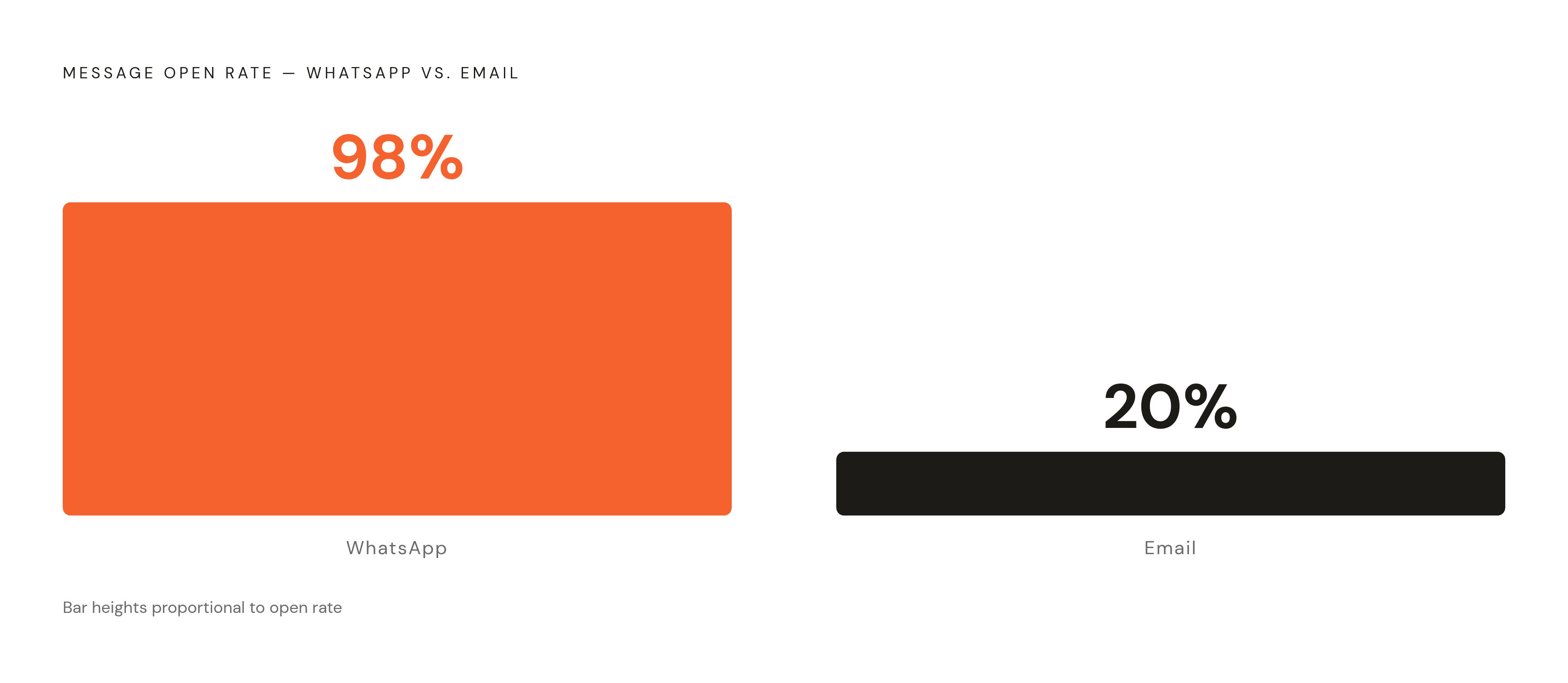
Start with the reach, because it's not close. WhatsApp messages get opened around 98% of the time. Email sits closer to 20%. That gap alone should decide where a business puts its customer-facing agent, and yet plenty of teams still default to email first because that's the tooling they already know.
Spain has 36 million users, and WhatsApp is installed on 95% of smartphones in the country. Nobody downloads a new app or learns a new interface. Meta paid down that adoption friction over the past decade, and any business building now gets to walk through the door for free.
Customer expectations have caught up too. By 2026, a reply within minutes, any hour, reads as normal rather than impressive. Human-only teams can't hold that pace without burning out staff or blowing past what the unit economics support, and that's the real driver behind the adoption curve: 41% of agencies now run at least one AI agent in production, up from 9% in early 2025. Whoever still thinks this is a niche experiment is reading last year's numbers.
AI Agent on WhatsApp vs. Chatbot
A chatbot follows a script. Feeding it something outside the script breaks it, causes a restart, or triggers a handoff to a human with zero context carried over. No memory between turns, no access to anything beyond its own decision tree.
An agent works differently. It reads the message, figures out what the person actually wants, queries a live system (a CRM, an order database, a knowledge base), and answers based on what it finds. It handles the question nobody scripted for because it's reasoning through the request, not matching it against a list of intents.
That difference appears in the metrics that actually matter to a business: fewer people abandon the conversation, more issues close without a human stepping in, and every exchange gets logged into whatever system runs the business instead of sitting in a transcript nobody reads.
An agent can do things a chatbot flatly can't:
- Answer "where's my order #45892?" by hitting a live logistics API and returning the real delivery window, not a canned "we'll email you soon"
- Reschedule an appointment end to end: check the calendar, confirm the slot, send the reminder, no human touching any of it
- Qualify a lead by collecting name, company, role, need, scoring the interest, and routing a structured summary to sales
- Escalate to a human with a full summary attached, so whoever picks up the thread isn't starting cold
How a WhatsApp AI agent is technically wired together
Lay out the message flow step by step and it's simpler than it sounds. A customer sends a message. The WhatsApp Business API receives it and fires a webhook to the Business Solution Provider (BSP) or whatever server is listening. The BSP hands the content to the agent (the LLM plus its tools plus whatever memory it's carrying). The agent decides if it needs to call something external, such as a CRM, an order system, or a calendar, makes that call, builds a response, and sends it back through the API. All of it, usually, in a few seconds.
Meta splits conversations into four categories, each with its own rules and rate structure: service (customer-initiated), marketing, utility, authentication. The category determines what can be sent and when. Anything a business initiates without the customer messaging first needs a pre-approved Meta template. Replies inside 24 hours of an inbound message don't need approval, since they run inside what's called the service window.
Past the language model itself, the runtime needs three things to survive contact with production traffic. Memory, so context from three messages ago, or three days ago, doesn't vanish between sessions. Tool access, meaning real, authenticated connections into whatever systems the business runs. And reasoning, to decide which tool to call, in what order, and when the job's actually done.
The two API paths: official BSP route vs. MCP/personal account route
Two ways to connect exist, and they carry very different risk.
The official route runs through the WhatsApp Business API via a Meta-approved BSP. Any business-initiated outbound message at scale has to go through it, and it's the only path that unlocks proactive notifications via approved templates. As of 2026 it remains the only path that keeps accounts in good standing with Meta's policies on consent, messaging, and account quality. Account quality rating caps message volume directly. Let the reputation slip and reach shrinks with it.
The other path runs through unofficial tools: personal WhatsApp accounts connected via QR scan, or bridges built on protocols connecting AI models to external tools, like a community-built WhatsApp connector or some third-party API. None of it needs Meta's approval, so it's faster to stand up. It also violates WhatsApp's Terms of Service outright, and accounts caught bulk-messaging get flagged and banned, sometimes within days. This route only makes sense for personal or internal tools where the volume stays small and the blast radius stays contained.
One rule holds across both paths: let the customer message first, then reply. Meta's systems reward that pattern. Cold outbound, the stuff nobody asked for, is what gets accounts banned.
Bot types map cleanly onto each path. An inbound DM bot handling support, FAQs, lead qualification, or booking belongs on the official route. A self-chat assistant for personal task tracking works fine on a personal account, as does an allowlist bot serving a fixed client list, or a group bot running as a team assistant, at small scale. A scheduled sender, pushing reminders or digests to people outside the builder's own contacts, needs the official route. No exceptions there.
Meta's 2026 pricing changes
Anyone still designing around the old conversation-based billing model is going to fail a cost review. Three changes matter most.
First, Meta's own Business Agent runs on token pricing: $2.00 per million tokens, with a typical message burning somewhere between 20,000 and 25,000 tokens. Work the math and that is around four to five cents per message, more for complicated responses, less for simple ones.
Second, the free tier on service messages is ending. Once a business clears 1,000 free delivered service messages a month, Meta starts charging per message, including service replies and utility messages sent inside the 24-hour window. That free tier holds through September 30, 2026, and then it stops holding.
Third, and easy to miss: Meta's Business Agent billing runs separate from whatever a third-party AI provider charges on top. A service message might get powered by a human or by a third-party AI system, and whoever built that system bills its own fee on top of Meta's. Two bills, one conversation.
Meta announced the Business Agent at its Conversations conference in London on June 3, 2026, an AI assistant built into WhatsApp, Instagram, and Messenger that eligible businesses turn on directly from the WhatsApp Business app, no code required. Over a million businesses were already testing it before the wider rollout.
Model the full cost stack from day one, not after the invoice arrives. Platform fees, Meta's per-message charges, token usage from whatever LLM runs the agent, and integration costs all stack on top of each other. At any real volume, that becomes a line item somebody has to defend because it no longer amounts to a rounding error.
Resilience requirements most builders skip
WhatsApp delivery isn't a clean, synchronous request-response channel, and treating it like one is where production agents fall apart. Webhooks arrive late. The same event fires twice. Calls drop mid-conversation. A template gets rejected by Meta's quality review with no warning. Someone sends a media file the agent has no idea how to handle.
Each of those needs a specific engineering answer:
- Idempotent event handlers, so a duplicate webhook doesn't fire the same action twice
- Delivery-state tracking, so the system knows what actually reached the customer versus what just left the server
- Retries that stop after a set number of attempts, not loops that run forever
- Fallback routes for when the primary delivery path fails outright
A compliance layer sits right on top of this. Where required, the customer needs to know they're talking to an automated or AI-assisted system, with a plain way to opt out, end the interaction, or ask for a human. That consent record has to live alongside the conversation log itself, not off in some compliance folder nobody opens until there's a dispute.
Choosing an agent runtime: how Hermes, OpenClaw, Claude Code, and Codex compare for WhatsApp use
The channel sets the requirements before any product decision gets made. Replies need to be fast. Context has to persist across sessions, sometimes days apart. Tools need to be callable reliably, and uptime has to hold at whatever hour a customer decides to text, because customers don't check time zones before they message.
Different runtimes suit different workloads, and the channel's demands, fast replies, persistent context, reliable tool calls, should drive the selection decision rather than familiarity with a particular framework.
OpenClaw earns its place when a workflow needs a deep bench of tools or channel integrations. It's open-source and self-hostable, which pushes the cost baseline toward zero for anyone running their own infrastructure.
Claude Code was built for a different job: coding assistance, developer tooling used through text interfaces. Putting it in front of customers on WhatsApp is the wrong call. It belongs further back in the stack, as a reasoning layer other systems call into, answering a customer's message about a late order.
Composio's Connection of an Agent to WhatsApp and a Business's Tool Stack
Authentication kills most agent integrations, not the model. OAuth flows, token refresh cycles, API key rotation, permission scoping across a dozen tools: that's real engineering overhead that has nothing to do with how smart the model reasoning is.
Composio exists to take that overhead off a builder's plate. It gives an agent authenticated access to third-party business apps through one managed layer instead of a separate integration for every tool. As of August 11, 2026, the catalogue lists 1,089 toolkits, exposing more than 20,000 individual tools an agent can call.
All of it runs through a single MCP endpoint, so the agent talks to one connection point instead of standing up a separate server for every service it touches. That alone cuts the integration surface down by a lot.
Composio-managed auth is the default: it handles OAuth flows, API key storage, token refresh, and permission scoping on the agent's behalf. At runtime, the agent connects to an account through a session instead of the builder wiring up credential management by hand for every tool in the stack.
Security and compliance requirements for a WhatsApp agent in production
Permission scope is where most production failures actually happen, and it's rarely a dramatic breach. Reported figures put it at 53% of organizations seeing AI agents exceed the permissions they were meant to have. That's an agent quietly doing more than it should, not an attacker breaking down a door.
Visibility across the industry is thin. Across the industry, most organizations lack a real-time registry of which agents are running and what they can touch, and security teams broadly report that their identity and access setups were not built with AI agent identities in mind.
Monitoring lags behind that. Most organizations do not track AI activity end to end, prompts, tool calls, and outputs logged together, and fewer still watch what happens when agents talk to each other.
For a WhatsApp agent specifically, these gaps turn into concrete risk fast. An agent with write access to a CRM can alter a customer record with nobody approving the change. A poorly scoped integration can leak one customer's conversation history into another customer's thread. Without logging built in from day one, there's no record to point to when a dispute lands on someone's desk.
None of this is exotic. It's the same identity and access discipline businesses have run on human employees for decades, just not yet applied with the same rigor to the software now making decisions on their behalf.