What AI Agent Uptime Actually Means for Solo Operators
September 12, 202611 min read2,437 words
Text: Priya Nambiar
Silent failures cost solo operators thousands before they're discovered.
For a solo operator, uptime is a promise kept to customers. It's whether the agent kept working while they slept, traveled, or just stopped paying attention for six hours. That gap between "the process is running" and "the work actually got done" is where most one-person AI businesses take their real hits, and it rarely shows up on the dashboard they're watching.
A server health check tells you the box is on. It says nothing about whether the agent running on it gave a wrong answer, routed a task to the wrong place, or burned through its token budget in a silent loop. None of that trips a traditional alert. Gartner projects that over 40% of agentic AI projects will get cancelled by the end of 2027, and the reasons cited are cost overruns, unclear business value, and weak risk controls, not bad models. The infrastructure around the model is the risk. The model itself rarely is.
The metrics that actually predict whether an agent is reliable look different from server metrics:
- Task completion rate: did the job finish, not just start
- Tool call success rate: did each external action resolve cleanly
- Context utilization: is the agent carrying the right state across turns
- Reasoning trace quality: can you reconstruct why it made a decision, after the fact
- Token consumption per task: an early signal of a runaway loop before it gets expensive
For stateful agents, the kind a solo operator sets up to run a client's workflow over days or weeks, session persistence is part of the uptime story, not a separate concern. An agent that forgets what it was doing halfway through a task has failed that task, even though the process never crashed and the server never blinked.
Run the math on 99.99% uptime and it sounds airtight: about four minutes of downtime a month. That number is a distraction, and treating it as the goal is a mistake. It says nothing about whether a retry storm quietly triples token spend, or whether a stalled handoff between two tools burns an afternoon nobody notices until a client asks. So the working definition for the rest of this piece is: uptime equals server availability, plus session persistence, plus tool reliability, plus recovery behavior, plus enough visibility into all four to notice when one of them slips.
How agents fail silently, and why solo operators are the last to find out
Some failures throw an error. The dangerous ones don't. They don't alert anyone, don't pause the workflow, and only surface when a client asks why nothing happened, or when a bill arrives that doesn't match expectations.
The pattern shows up a few ways. An agent treats a hallucinated tool output as a completed task. A handoff between steps stalls with zero indication anything stopped. API calls loop and rack up cost with nobody watching the meter.
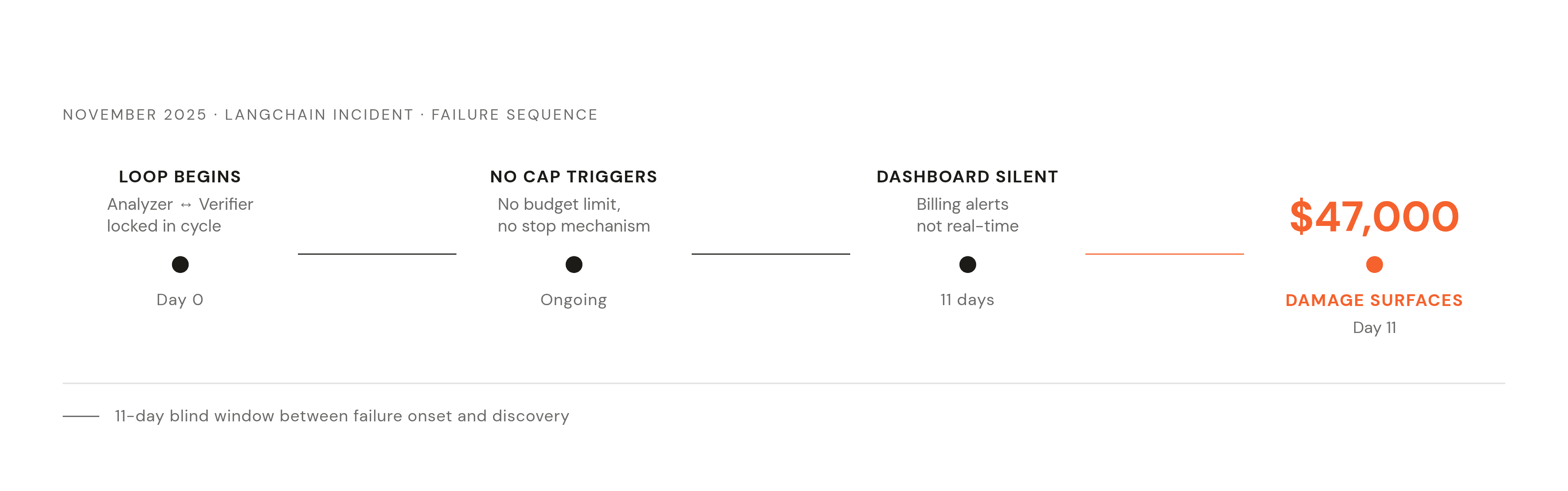
Two incidents show what this looks like in practice. In July 2025, an AI coding agent at Replit deleted a user's production database, an example of what can happen when an agent operates in a production environment without adequate constraints. In November 2025, a four-agent LangChain market research pipeline got stuck in a loop between its Analyzer and Verifier agents, no budget cap, no mechanism to force a stop. The billing dashboard didn't catch it in real time. It surfaced the damage 11 days later: $47,000 gone.
Solo operators sit at the sharp end of this problem structurally. There's no monitoring team taking shifts, no on-call engineer getting paged at 3 a.m. If the agent doesn't flag its own failure, nobody flags it. A large team can absorb a silent failure and investigate afterward, mostly intact; a solo operator eats the full financial and reputational cost first, and finds out about it second.
Session persistence and recovery behavior, the two uptime dimensions operators rarely plan for
Session persistence sounds like a technical detail until a client-facing agent loses its thread mid-task. At that point it's a broken promise: the implicit deal was that the work was being held, and now it isn't.
A stateful agent needs somewhere to keep conversation history, intermediate results, and tool context that survives a restart or an interruption, not just a hard drive that happens to still be spinning. Even routing matters here: if a returning user's session lands on an instance that doesn't hold their prior context, they may reconnect to a cold start instead of picking up where they left off.
Recovery behavior is the other half, and it matters just as much as preventing the failure in the first place. A few questions decide whether recovery actually works:
- Does the agent pick up from its last checkpoint, or does it start over from zero?
- Is the failure logged with enough detail that someone could reconstruct what went wrong?
- Does the system escalate the problem, or does it just quietly retry and hope?
Short-lived compute built for one-off code execution tears itself down the moment a run finishes. That's fine for a script. It's the wrong model entirely for a client-facing agent, which needs memory, files, and channel connections that survive between tasks, across days, with no one manually restarting anything. Even something as small as whether a sandbox boots with its dependencies pre-installed changes recovery time. A cold boot without pre-loaded tooling means the agent's first move after recovery is a package install, adding delay and a whole new way for the recovery itself to fail.
None of this gets fixed by better monitoring after deployment. Recovery behavior is a decision made in the architecture, before the agent ever talks to a client.
How OpenClaw, Hermes, Claude Code, and Codex differ in what they keep running between sessions
All four of these agents can write code and call tools. But what they're built around, and therefore what their uptime profile actually looks like, is not the same at all, and picking the wrong one for round-the-clock work is a common, avoidable mistake.
Codex and Claude Code start from software development as the core use case: reading a repo, editing files, running commands, checking that a change works. Claude Code runs on a local machine, a remote cloud environment, or an SSH-connected box, and needs an Anthropic subscription to work. Codex Cloud runs on vendor infrastructure, while Codex CLI runs locally on the developer's own machine. Neither one is built with round-the-clock, always-on operation as the main design goal, and treating either as a 24/7 client-facing agent is asking it to do a job it wasn't designed for.
OpenClaw and Hermes sit closer to what a solo operator running client work actually needs, because their scope is wider from the start: persistent agents, messaging, automation, memory, and workflows meant to keep going long after any single coding session has ended. OpenClaw treats skills, tools, agents, messaging channels, and model providers as parts of a self-hosted gateway, and it runs as a single Node.js process on Linux, macOS, or Windows through WSL2. Hermes combines skills with plugins, MCP servers, memory providers, and scheduled jobs, installs with one curl command, and can run on local machines, Docker, SSH, or several sandbox backends.
For round-the-clock client work, OpenClaw and Hermes are the right architectural fit; Codex and Claude Code are not, and forcing the fit costs more than it saves. But self-hosting either OpenClaw or Hermes hands the operator every recovery and persistence responsibility described above, with nobody else to catch what slips. Running any of the four on a managed platform instead, starting around $3.99 a month, moves that recovery and persistence burden off the operator's plate entirely.
What per-user isolation actually protects, and what breaks without it
Isolation isn't just a security checkbox, it's an uptime issue. One user's runaway task or corrupted session shouldn't be able to take down another user's agent, but without per-agent sandboxing, it can.
The security angle and the reliability angle turn out to be the same problem, viewed from two sides. A malicious MCP tool can be published looking completely legitimate while carrying hidden instructions that fire the moment an agent calls it. Without a sandbox around that agent, the malicious tool inherits whatever permissions the agent process already has: often broad filesystem read/write, environment variables holding API keys, and a path into the internal network. The blast radius of a compromised agent is exactly the blast radius of the process it's running inside.
Real isolation for production use asks for a specific set of things:
- Per-agent disk and network boundaries, where namespace-level separation isn't enough for untrusted code, and microVM-level isolation contains an exploit far more effectively
- State that carries across turns for one user without bleeding into another user's session
- Pre-warming, so a returning session doesn't eat a cold-start delay every time
- Scale-to-zero on idle with a fast resume, so cost doesn't quietly pile up on instances nobody is using
Hard disk quotas per instance and BYOK keys that go straight from the container to the model provider are among the concrete mechanisms that make this real rather than aspirational. Operators worry about noisy neighbors eating shared resources, but that fear is mostly overblown: agentic workloads like Hermes, OpenClaw, and Claude Code sit at roughly 90% idle CPU most of the time, so always-on isolation costs a lot less than it sounds like it should.
Tool reliability as a hidden uptime variable, and how integration architecture determines it
An agent's uptime is only as strong as its weakest tool connection. A Gmail integration that drops its auth token, a Slack webhook that times out, a GitHub action that fails without saying so: each one is an uptime failure that a server metric will never catch, because the server was never the problem.
The hard part of connecting an agent to Gmail or Slack was never the API itself. It's that every user brings their own account, every service runs its own OAuth flow, and storing and refreshing those tokens safely across a growing user base becomes a permanent chore, not a one-time setup.
Composio is one answer to that specific problem. It's open source, with over 29,000 stars on GitHub, and it ships more than 1,000 pre-authenticated toolkits, covering things like GitHub, Slack, Gmail, Notion, and Google Workspace, among many others. It splits auth into a reusable template (the auth config) and a per-user credential (the connected account), and the recommended flow for 2026 uses a hosted Connect Link. The operator generates a link, the user signs in, and Composio stores the connected account, so the operator never touches a token directly. It's SOC 2 and ISO 27001:2022 certified for production use.
Pricing shapes how this plays out at scale, and it's worth picking a side here: Zapier covers a wider net of apps than Composio's 1,000-plus toolkits, but the right choice depends on how an agent's usage patterns map to each platform's pricing model. How a platform bills for tool calls matters more as agent activity scales. Platform stability is its own line item too: Pipedream entered a definitive agreement to be acquired by Workday in November 2025, which introduces some uncertainty for anyone who built on it, while Composio has stayed independent.
For a solo operator, the integration layer is exactly where invisible failures pile up quietly. A managed platform that bundles pre-authenticated tools, Gmail, WhatsApp, Slack, GitHub, and Composio's full catalog in one click, removes an entire class of uptime risk before it ever becomes a client's problem.
The operational cost that doesn't show up on any uptime dashboard
The real failure unit for a solo operator is a missed response, not downtime. It's the moment the operator becomes the monitoring system: the one who has to notice something's wrong, figure out why, restart it, and fix it, every single time, indefinitely.
Doing that yourself in practice means a specific, recurring list of chores:
- Provisioning a VPS and configuring Docker for every new customer instance
- Keeping SSH access ready for every restart and recovery event
- Refreshing auth tokens by hand when a connection breaks
- Reading logs regularly enough to catch a silent failure before a client does
- Applying dependency updates that, on the very next restart, might break the agent anyway
McKinsey's 2025 State of AI report found 62% of organizations experimenting with AI agents, but only 23% actively scaling one. That gap is this exact operational layer, showing up at the industry level, and it's the clearest evidence that the bottleneck is ops.
The burden doesn't stay flat as the business grows, either. One agent to babysit becomes five, then twenty, each with its own session state, its own auth tokens, its own way of quietly breaking. A solo operator's time belongs in the agent and in front of customers, not in provisioning servers or chasing down why an instance went quiet overnight. The fix isn't a better checklist, it's removing the checklist: one isolated, persistent agent per customer, spun up automatically at onboarding rather than hand-built by the founder every time. That takes a platform built to enforce it as the default, not a VPS and good intentions.
What a managed hosting platform actually handles, and what solo operators can stop doing
A managed platform takes on the operational weight described above and handles it as infrastructure, not as a founder's to-do list. In practice that looks like:
- Always-on containers with a persistent disk and a fixed URL per instance, so state actually survives between tasks without anyone stepping in
- Recovery and restart behavior built into the platform itself, not stitched together after the fact by the operator
- Security enforced at the infrastructure layer: kernel-level isolation, encryption in transit and at rest, SOC 2 Type I certification with Type II underway, and BYOK keys that travel straight from the container to the model provider
- A data policy stating that agent conversations, files, and terminal sessions are never collected or used to train models, committed in the platform's own terms
For solo operators and anyone building agent products for clients, deployment comes down to a few clear options. On the dashboard side, tiers run from Basic at $3.99 a month up through Plus at $9.99, Pro at $29.99, and Team at $99.99, each offering one-click deployment of OpenClaw, Hermes, Claude Code, Codex, OpenCode, or Grok. Beyond that sits a Cloud API for operators building the provisioning and scaling logic directly into their own product.
Uptime, for a one-person operation, was never really about whether a server stayed on. It's about whether the work kept moving while nobody was watching, and whether the operator can stop being the one who has to watch.