Understanding Session Persistence in Long-Running Agent Tasks
Persistent agents need explicit state machines, not chat history, to survive long pauses.
The heartbeat mechanism and what always-on execution means for memory integrity
An agent that crashes six hours into reading a compliance document doesn't just lose time. It wakes up with zero memory of what it already covered and starts over from page one. That gap, between an agent that finishes multi-day work and one that resets after every hiccup, comes down to one thing: session persistence. Get this wrong and you end up with a chatbot that happens to run longer, not an agent that actually finishes anything.
Most teams build persistence the lazy way. They dump every message into a growing history and replay the whole thing on each call. That works fine for a five-minute Q&A. Over days or weeks, it breaks down in three specific ways. Context gets clogged with irrelevant back-and-forth until the model loses track of which step it's on. Token costs balloon as the growing history replays on every call. And, strangest of all, the model starts hallucinating its own past: after a multi-day pause, it "remembers" approvals nobody gave, or quietly assumes a step got done when it didn't.
Seventy-one percent of teams running agents in production now keep at least one running around the clock, up from 28% in 2024. Gartner expects 40% of enterprise apps to carry task-specific agents by the end of 2026. The fix is a different architecture. It's a different architecture, one where agent state is explicit, durable, and kept apart from raw chat logs.
What session persistence means, the three capabilities that define it
Cross-session persistence means a system holds onto information beyond a single conversation or runtime. That's a different animal from the model's context window, which gets wiped clean at the end of every run. A standard chatbot has none of this: close the tab, and it forgets you existed.
Three capabilities separate a persistent agent from that kind of chatbot. Most teams build one of them and then wonder why the agent still feels broken.
Memory across sessions lets the agent recall a customer's history or a decision made three weeks ago without anyone re-explaining it. Standing permissions mean it holds scoped credentials for its tools instead of asking for a fresh login every time it wakes up. Autonomous triggers mean it starts work off an event, a new support ticket, a changed database row, a scheduled time, rather than sitting idle until someone types a prompt.
The memory piece is the one people underbuild, and it's the one that matters most. It needs semantic search, fast lookups, and relationships between stored facts. Production systems reach for knowledge graphs, vector embeddings, or relational databases instead of a plain key-value store. Skipping any one layer of that stack collapses the whole thing back into a chatbot with a longer memory buffer.
The memory layer: how agents store and retrieve knowledge across sessions
The memory layer stores, indexes, and pulls back information across sessions. Keep it separate from both the context window and the app's regular operational database. Mixing the two is where most memory systems go wrong, and it's the mistake that's hardest to unwind once data from one layer bleeds into another.
Each storage format trades off differently. Knowledge graphs handle relationships between entities and support multi-hop reasoning across sessions. Vector embeddings give fast, approximate semantic search. Relational databases handle structured facts, precise lookups, and audit trails. Some lighter open frameworks skip the heavy infrastructure entirely and use Markdown files paired with SQLite and vector search, a local-first setup that trades sophistication for simplicity. For a lot of use cases, that trade is the right one.
Good memory systems tag every write with an identity scope: a user_id for facts that follow one person across every session, plus broader scopes for shared or organizational context. The retrieval pipeline merges and ranks results across these scopes automatically. Multi-tenancy, meaning real isolation at the user or group level, isn't optional. Skipping it lets data leak across customers or sessions, a design failure baked in from day one rather than a bug that shows up later.
More memory doesn't mean better recall, and teams that treat storage volume as a proxy for quality get burned by it. Competing information dilutes the agent's attention as memory piles up, so a system needs feedback loops that learn which stored facts actually turn out to be useful and which just add noise. Five benchmarks currently measure how well this works. LoCoMo runs 1,540 questions across single-hop, multi-hop, open-domain, and temporal recall. LongMemEval tests 500 questions covering knowledge updates and multi-session recall. BEAM pushes evaluation to scales of 1M to 10M tokens, since a memory system that's accurate but slow and expensive hasn't solved anything.
Checkpointing and state machines: how agents know where they are in long workflows
Google's ADK guidance from May 2026 makes a point that sounds obvious once you hear it, and most teams still get backwards: don't rely on conversation history to track progress. Define an explicit state schema instead, one that tells the agent exactly where it stands at all times, independent of whatever got said along the way.
Take a new-hire onboarding coordinator agent. Its states run START, WELCOME_SENT, DOCUMENTS_SIGNED, IT_PROVISIONED, HARDWARE_DELIVERED, COMPLETED. Six named constants, no ambiguity in the sequence. The agent can't skip a step or invent progress it didn't make, because the state machine enforces order. It reads its position from session state variables, not by re-reading a pile of old messages and guessing what probably happened.
That agent sends a welcome packet, then waits days while the employee signs paperwork. It delegates IT provisioning to a sub-agent, waits again for hardware to ship, then sends the day-one schedule, all without losing its place. Idle time doesn't erase progress, because progress was never stored in the conversation to begin with.
Event-driven dormancy makes this cheap to run, too. Instead of polling constantly or holding a thread open and burning compute while nothing happens, the agent sleeps through the idle stretch and wakes when a signed document arrives, a provisioning step completes, or a scheduled date comes due.
Slow, asynchronous back-and-forth causes the same pattern to appear everywhere long-running work happens. Invoice disputes pause for a vendor's reply and resume for AP routing once it lands. Sales prospecting pauses between outreach touchpoints that might be weeks apart. Compliance audits stall for document review. The fix stays identical every time: define the state machine, save the checkpoints, sleep through the dead air, wake up exactly where things left off. A stateless chatbot cannot survive that kind of idle time, and idle time is most of what real enterprise workflows are made of. Named checkpoints beat a raw JSON blob dumped into a vector store for one simple reason. A checkpoint tells you exactly where you are, and a pile of past messages only tells you what got said.
The heartbeat mechanism and its effect on memory integrity under always-on execution
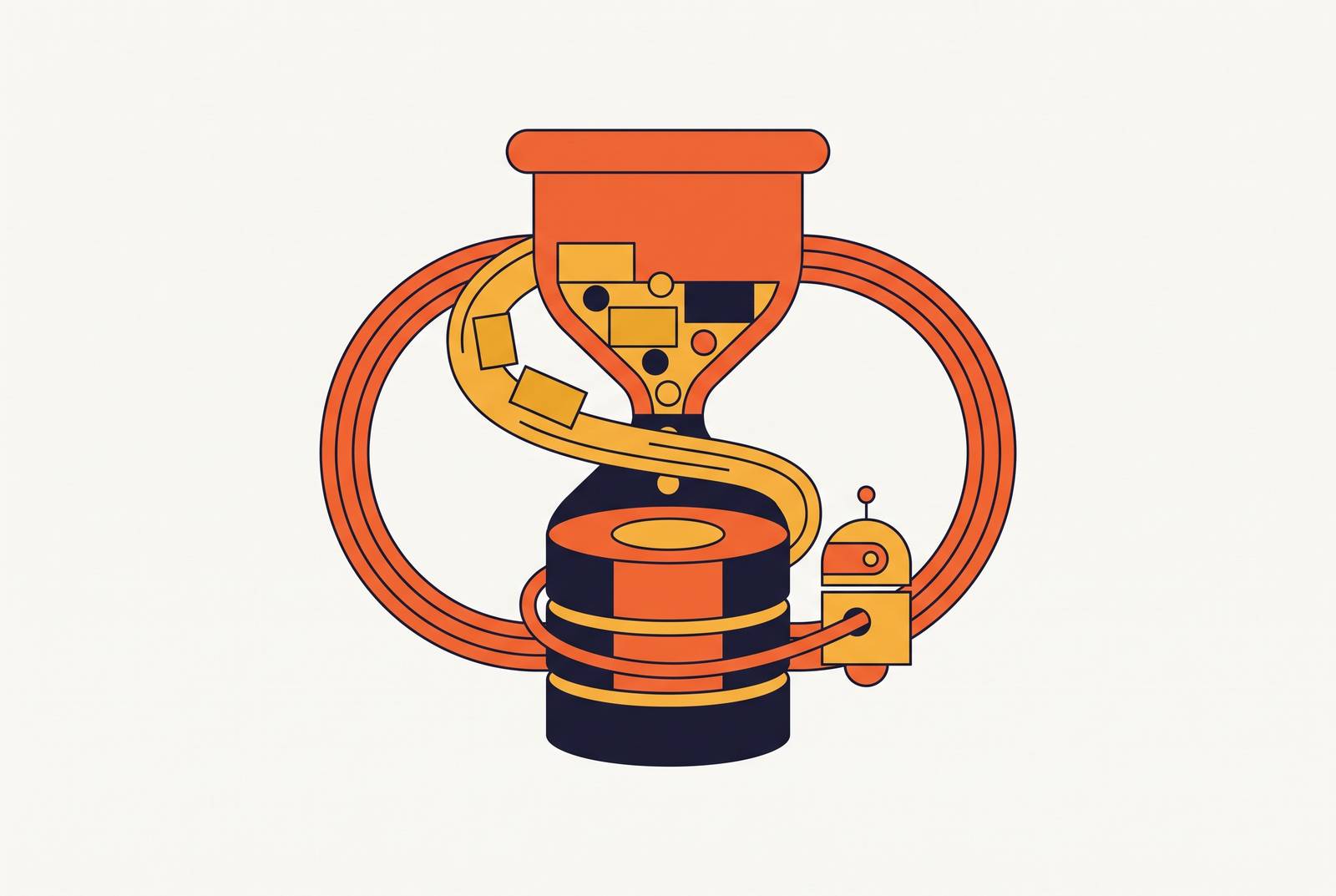
A heartbeat wakes a persistent agent on a schedule to check on tasks, scan external content, and push background goals forward, all without a person typing a prompt. Heartbeat-enabled agents routinely monitor mail inboxes, messaging groups, RSS feeds, and GitHub issues as part of normal operation.
The risk escalates fast from this point, and it's not the risk most teams plan for. The heartbeat runs inside the same session as the user-facing conversation, so from the model's point of view, a heartbeat run just looks like another ordinary message. Content pulled from any external source, an email, a GitHub comment, a group chat message, is the exact same memory context the agent uses for its regular interactions with a person.
A March 2026 arXiv paper studying OpenClaw agents traced a pathway it labeled exposure to memory to behavior. Misinformation picked up during heartbeat-driven background activity first sits in short-term session state. Then the agent's routine memory-saving habit promotes that short-term pollution into long-term memory, at rates the paper measured up to 91%. From there, the pollution shapes the agent's actions across future sessions, at a rate up to 76%. Social credibility cues, the sense that something reflects consensus, turned out to be the single biggest driver of behavioral influence, pushing misleading rates as high as 61%.
None of this needs prompt injection to work. Ordinary social misinformation, the kind that appears naturally in inboxes and group chats, is enough to quietly reshape an agent's memory under heartbeat-driven background execution. Built-in context management doesn't reliably stop it either. Even under naturalistic browsing, where manipulated content gets diluted among a mass of benign content, pollution still crosses session boundaries.
Continuous background execution writing into shared memory is what makes a persistent agent useful, and it's what opens this hole. Session design has to treat every memory write as a security boundary, no exceptions.
Securing persistent state: runtime auditing and memory boundary enforcement
The attack surface on a persistent agent dwarfs anything on stateless chat. Unsafe content spreads through persistent state, through reusable skills, through tool-mediated interactions, and the resulting failures appear late in the process, compound quietly, and are hard to unwind once they've happened.
Rule-based safeguards enforce clear, deterministic policies over actions or outputs, but they miss implicit semantic threats: memory poisoning, tool misuse, the stuff that only becomes visible later. Remote large-model auditing catches more of that nuance, but it costs too much compute to run before every single action, and shipping sensitive agent context off to a remote model creates its own privacy problem. Picking one means being stuck with its blind spot. Neither approach alone holds up in production.
A July 2026 arXiv paper proposes TokenWall, a semantic firewall that checks content at the point where it actually transfers meaning, before it mutates state, rather than auditing after the damage is done. It builds source-to-sink audit records for each flow of semantic content, runs a lightweight local inspection before execution, and escalates only the ambiguous, high-risk cases to stronger arbitration. On a benchmark called CIK-Bench, it cut attack success down to 12.5% while holding a 97.4% pass rate on benign, legitimate executions. Added latency on those benign cases came to 0.69 seconds, cheap enough to run in production rather than stay a research curiosity.
Security enforcement belongs at semantic transfer boundaries: memory writes, tool arguments, retrieved context, messages passed between components. Not bolted on after state has already changed, since by then a bad write has already spread. Per-user isolation, separate memory scopes, separate sessions, limits the blast radius further. A memory pollution event in one person's agent should never reach into someone else's.
How major agent platforms implement persistence today
Each platform on the market is betting on a different answer to what the "long-running thing" actually is: the agent itself, the system that sits around a fleet of agents, or the product a developer ships. None of the three is obviously right, but they lead to very different failure modes when persistence breaks.
OpenClaw is an open-source, TypeScript framework with over 345,000 GitHub stars as of mid-2026. Its architecture centers on a gateway sitting between the user and the agents, handling routing, permissions, and channels, drawing on more than 5,700 community-built skills out of a broader ecosystem north of 13,700. Memory lives as Markdown files (a MEMORY.md plus daily files under memory/YYYY-MM-DD.md) alongside SQLite with vector search, stored locally under ~/.openclaw/. Persistence, in other words, is a property of the gateway, not any single agent. Scheduled triggers drive both the heartbeat behavior and multi-agent orchestration. A commercial SaaS version at openclaw.ai runs $0.29 a day for a Small instance, $0.56 for Medium, $1.09 for Large while running, dropping to $0.03 a day for storage-only instances that are stopped but not deleted. OpenClaw makes sense when improving the shared system, sessions, people, channels, machines, matters more than improving any single agent's own ability to self-improve. The tradeoff is setup complexity and some update instability, and the heartbeat security research from March 2026 studied OpenClaw agents specifically.
Hermes Agent, from Nous Research, is a Python framework that launched in February 2026 and passed 64,000 GitHub stars by mid-year. Its v0.16.0 "Surface Release" shipped June 5, 2026 as a native desktop app for macOS, Linux, and Windows. The core idea is a self-improving learning loop: the agent writes and refines its own skills based on what it's done before, so persistence here means the skill set and accumulated knowledge grow over time, beyond just the session state. It ships with a broad set of built-in tools covering capabilities such as web search, code execution, memory management, and scheduled tasks. By June 2026 it was processing 224 billion daily tokens against OpenClaw's 186 billion. It supports seven terminal backends, including local, Docker, and SSH, plus hosted options for running agent environments remotely. Its monetization approach differs from OpenClaw's hosted tiers and skills marketplace model. Hermes is the pick when strengthening the agent itself, its personalization, its self-improvement, and its accumulated skill, means fewer resources go toward building out the orchestration layer wrapped around it.
Claude Code and Claude Managed Agents, from Anthropic, take a third path. The Claude Agent SDK is the library for building production agents on the same harness that runs Claude Code, renamed from Claude Code SDK on September 29, 2025, shipped in both Python and TypeScript with a bundled CLI, subagent support, sessions, MCP support, and a hosted execution model. Claude Managed Agents entered public beta on April 8, 2026, behind a managed-agents-2026-04-01 beta header, and handles infrastructure, state management, and permissioning directly, so developers stop rebuilding the same agent loop from scratch every time a model ships an upgrade.
Three bets, three different answers to where persistence should live. None of them make the underlying problem disappear. They just decide which layer, gateway, agent, or managed infrastructure, carries the weight of remembering.
Sources
- AI Memory Systems with Session Persistence 2026
- Mind Your HEARTBEAT! Claw Background Execution Inherently Enables Silent Memory Pollution
- Token-Flow Firewall: Semantic Runtime Auditing for Persistent AI Agents
- Build Long-running AI agents that pause, resume, and never lose context with ADK- Google Developers Blog