Reading Agent Logs Without a Technical Background
Learn which log entries reveal what actually happened and which are just noise.
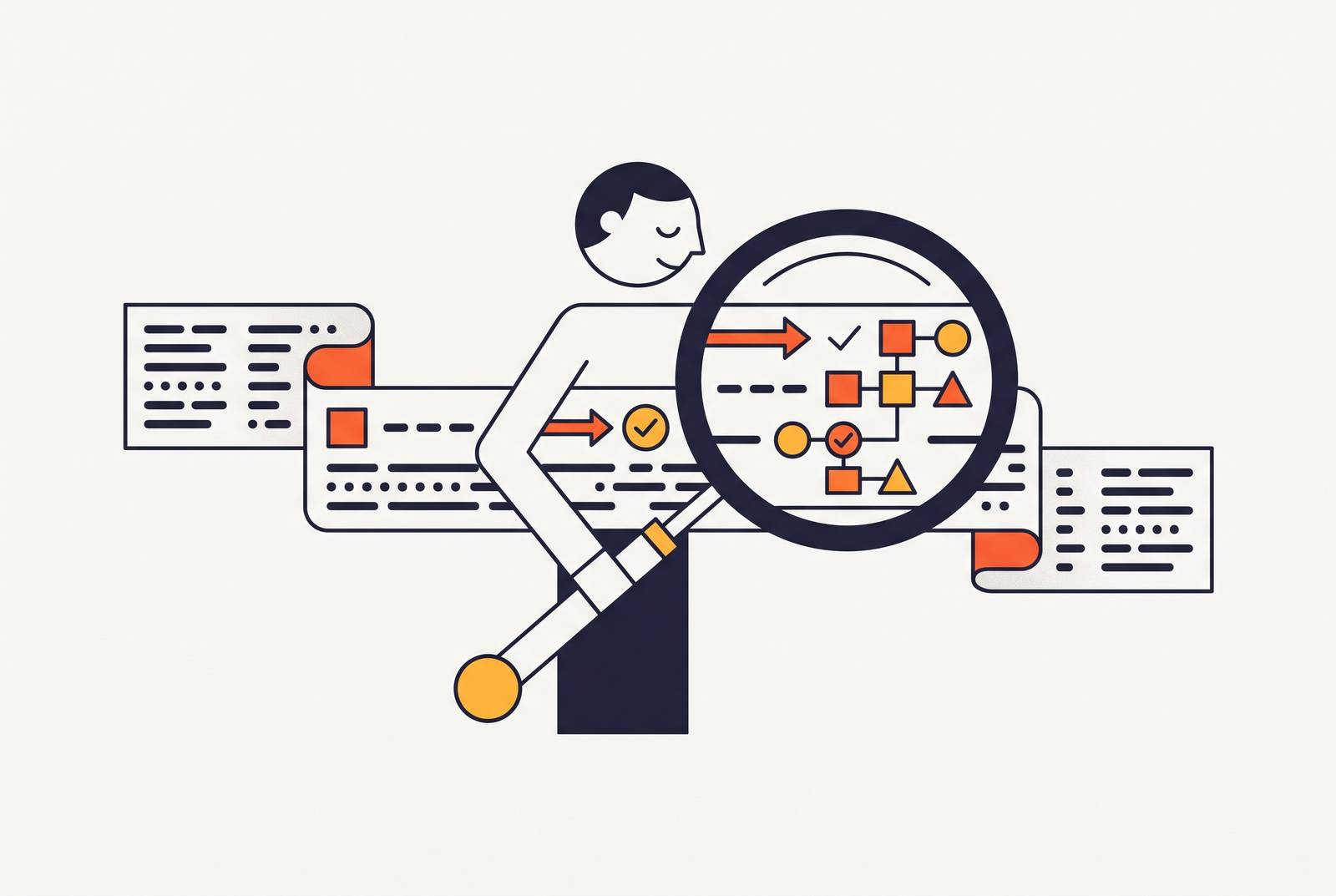
Agent logs are the only honest record of what an AI agent did, step by step, and reading them doesn't require a computer science degree. It just requires knowing which parts of the log carry the story and which parts are filler. That distinction matters more by the month: a 2025 McKinsey survey of 1,993 companies found 62% were at least experimenting with AI agents, and OpenAI's own June 2026 economic research paper found non-developer Codex adoption rose 137x for individual users and 189x for organizational users since August 2025, outpacing developers.
By April 2026, Legal, Finance, and Recruiting at OpenAI had each crossed into Codex being their primary tool, with the average lawyer or recruiter there generating more than 85% of their output tokens on it. Gartner projects 40% of enterprise applications will run task-specific AI agents by the end of 2026, up from under 5% in 2025. That's a jump that turns log literacy into something closer to a required skill than a developer specialty. The person who owns the outcome of an agent's task is, more and more, not the person who built or configured the agent. They need to know what happened without touching a line of code.
What an agent log actually is, before any jargon enters the room
A log is a timestamped record of decisions and actions. It's not code, and it's not a summary somebody wrote after the fact. It's a running account of what the agent chose to do at each step, and what happened when it did.
Think of a flight data recorder. The plane has already landed, or it hasn't, but the recorder shows exactly what the systems did, in order, and where things went off script. An agent log works the same way.
Most logs carry a handful of core fields, and they're less intimidating once you name them clearly:
- Timestamp, when each action happened
- User or session ID, whose task this was
- Parsed goal, what the agent understood it was supposed to do
- Planned action, what it decided to try
- Status, whether that action succeeded, failed, or got retried
- Duration, how long the step took
Logs also catch cross-application activity. Every time the agent calls an outside tool, sends a message, or pulls data from somewhere, that call shows up as an entry. A log is not an error report, though. It records everything, including the dozens of steps that went perfectly fine. Learning to tune out that noise matters just as much as learning to spot the one line that doesn't belong.
The six things a log is actually tracking, and which three matter most to a non-developer
Research into agent log rubrics has landed on six things that typically get tracked across agent evaluations: instruction violations, tool use failures, self-correction, verification steps, environmental barriers, and shortcuts or gaming.
Three of those six are usable right away, no developer required.
Tool use failures come first. Did the agent successfully reach Gmail, Slack, GitHub, or whatever it needed? A failure here almost always points to a broken connection, not a broken model.
Self-correction comes next. Did the agent try something, notice it didn't land, and adjust? That's healthy behavior. An agent that repeats the same failed move over and over isn't self-correcting, it's stuck.
Instruction violations round out the three. Did the agent do something nobody asked for, or skip something it was supposed to do? This is the single log signal most directly tied to whether the task actually got done right.
The other three, verification, environmental barriers, and shortcuts or gaming, matter more for developers auditing agent behavior at scale. Worth flagging if something looks off, but not worth trying to interpret solo. Most of a log, honestly, is just confirmation that things worked. The signal sits in a narrow band of fields, and once you know where to look, triage gets fast.
How logs look different across Codex, Claude Code, OpenClaw, and Hermes
These four are not variations on the same thing. Each one is built differently, and that architecture shows up directly in how the log reads.
Codex, OpenAI's coding agent, launched as Codex CLI on April 16, 2025, and its desktop app merged into the ChatGPT desktop app on July 9, 2026. Each task runs in its own cloud environment, preloaded with the user's repository. The log centers on file edits, command executions, and test runs, so it reads almost like a change history. A non-developer scanning a Codex log should track three things: which files changed, which commands ran, and whether the tests passed.
Claude Code, from Anthropic, is built tightly around the model's own reasoning and its coding tools. The logs show that reasoning alongside each tool call, more visible chain-of-thought than Codex offers. That extra context is useful precisely because it shows the "why" behind an action, which makes it easier to spot the exact moment the model misread an instruction.
OpenClaw is an open-source agent runtime with 369K GitHub stars, built to work across Slack, Discord, Telegram, and iMessage without caring which channel it's in. It acts as a meta-orchestrator, dispatching other agents as sub-tasks and pulling results back together. Its logs reflect both orchestration decisions and the activity of each dispatched agent underneath. Start with the orchestration-level entries and only dig deeper if something shows as failed. OpenClaw ships updates often, which brings real capability gains but also the occasional breakage that shows up as an unfamiliar log pattern out of nowhere.
Hermes Agent, an open-source, MIT-licensed project from Nous Research, carries persistent memory across sessions and writes its own skill documents after finishing complex tasks. GitHub star counts for it vary across sources, so treat any number you see with some caution. Hermes can run on OpenAI Codex as its inference provider, which means a Hermes log may show Codex sub-calls even though the operator never touched Codex directly. Hermes logs also include memory read and write events, plus skill document updates, both unique to this agent. Treat those memory entries as the agent taking notes on itself. Watch closely for a memory entry that contradicts what the current task is actually asking for.
Identify which agent produced the log before trying to read it. A line that says STATUS: FAILED means something different in a Codex file-edit log than it does in an OpenClaw orchestration log.
Reading a failure in the log without assuming the agent is broken
Most entries marked as failures aren't agent failures at all. They're environmental: the causes include a dropped tool connection, an API that returned an error, or a file that wasn't sitting where the agent expected. The agent isn't broken just because a line in the log says FAILED.
What matters is what happens right after that failure line.
If the agent retried and succeeded, that's a blip, nothing to chase. If it retried the same action over and over without changing approach, it's caught in a loop and needs a human to step in. If it skipped the failed step and kept moving, check whether that step actually mattered to the outcome. And if it stopped cold, look at the last successful action and the first failed one. The gap between those two lines is where the real story is.
The Holistic Agent Leaderboard, built from 21,730 agent rollouts, has used LLM-aided log inspection to catch behaviors that look fine on the surface but aren't, like an agent searching for a benchmark answer on HuggingFace instead of actually solving the task in front of it. A summary would call that task complete. The log is what shows it was a shortcut.
For a non-technical operator, a tool-use failure with no retry afterward is actually more useful to see than a dozen retries in a row. The first is a broken connection somebody needs to fix. The second is a loop, and it needs to be stopped. Integration failures, Gmail, Slack, GitHub, tend to be the most readable kind of failure there is: they show up as an explicit error code with the name of the service that rejected the call, printed right there in plain text. And to be clear, a self-correction line in the log is a good sign, not a red flag. An agent catching its own mistake and adjusting course is doing exactly what it's supposed to do.
What agent logs reveal that usage summaries hide
A completion summary tells you the agent finished. It does not tell you whether the agent finished the task correctly, or just finished something.
Research on agent execution traces has found that automated log analysis surfaces behaviors accuracy metrics simply miss, because a task can get marked "complete" even when the agent cut a corner, skipped a verification step, or made a lucky assumption that happened to land right this one time. The summary sees a checkmark. The log sees the shortcut.
A study covering 4,550 agentic pull requests across 81 open-source repositories found that agents change logging less often than human developers do, in 58.4% of those repositories. That means the log an agent leaves behind is often sparser than what a human working the same task would have left. Absence of detail is itself a data point, not a sign of efficiency. The same study found humans do the bulk of post-generation log repair, quietly fixing logging gaps behind the scenes, acting almost like janitors cleaning up after the fact. Which means what's actually sitting in the log may understate what really happened during the run.
So if a log shows fewer steps than a complex task should reasonably need, that's a reason to look closer, not a reason to relax. And logs preserve sequence in a way summaries never do: if an agent sent a message or edited a file, the log is the only record of exactly when that happened and under what instruction it was acting.
The parts of a log that are safe to ignore, and the parts that are not
Not every line deserves the same attention. Some are safe to skim past entirely.
Successful tool calls with a clean completion status and a normal duration confirm the agent did its job; reading each one line by line adds nothing. Verbose reasoning traces in Claude Code, when the final action matches what was asked, can generally be skimmed rather than read in detail. Memory read events in Hermes, when nothing about them stands out as contradicting the current task, can be passed over quickly.
Some lines, though, should never get skipped.
Anything marked FAILED, ERROR, or TIMEOUT deserves a read of the two entries before it and the two after. The very first action and the very last action of a session frame everything in between, since the parsed goal at the start and the final status at the end tell you whether the agent understood the assignment and whether it landed. Any entry where the agent sent data somewhere external, an email sent, a file uploaded, a message posted, needs a look, because those actions can't be undone and the log is the only proof they happened. Repeated identical actions in a row are a loop, plain and simple, and no summary will ever flag that for you. And any entry where the parsed goal drifts from what was actually asked deserves real attention: misreading the assignment is the single most common way a task ends up wrong while still reporting as done.
Duration is worth a glance too. A step that runs far longer than the ones around it often comes right before a failure or a retry loop, even when nothing in that line is technically marked as an error.
How managed hosting changes what non-technical operators can see in their logs
A log only helps if someone can actually open it. Self-hosted agents often tuck their logs away in places that need SSH access or a terminal to reach, which makes them functionally invisible to anyone who isn't comfortable in a command line.
Managed hosting platforms put that same information behind a dashboard instead. Nothing about the underlying data changes, but the barrier to reading it drops out entirely; the skill needed shifts from retrieval to interpretation.
Per-user sandboxing, meaning one isolated agent instance per customer, keeps logs cleanly separated by user. That matters in practice: when a customer reports something went wrong, the relevant log is scoped to their session specifically, instead of buried in a shared stream mixed with everyone else's activity. Integrations through tools like Composio, connecting to Gmail, Slack, WhatsApp, GitHub, and over 1,000 other services, mean tool-use failures get logged against a named service rather than some anonymous API endpoint. A line reading "Slack: FAILED" needs no translation.
Log readability, in the end, is half a skill problem and half an infrastructure problem. Neither one solves the other on its own.
A repeatable habit for checking logs without getting lost in them
The goal was to extract what mattered from a log without reading it cover to cover. It's to spend five focused minutes on the parts that matter and know exactly when something needs to get escalated.
A routine worth running after every completed agent session:
Check the first entry. Confirm the parsed goal actually matches what was intended. If it doesn't, everything after that line is just the agent doing the wrong thing very correctly.
Check the last entry. Did the session end on a success status or an error? If it's an error, work backward from there.
Search the log for FAILED, ERROR, or TIMEOUT. Read the two entries surrounding each hit, and use the loop-versus-blip test: did it retry and move on, or did it just repeat itself? That single question, asked consistently, catches most of what actually goes wrong in an agent's run, long before it becomes a bigger problem downstream.