
Pausing and Resuming Agent Schedules During Vacations
October 8, 202610 min read2,213 words
Text: Derek Tran
Explicit state schemas let agents survive pauses without losing context.
Pausing an agent for a vacation sounds like flipping a switch, but the switch has to account for everything the agent was holding in its head at the moment you flip it. Most agent tutorials build toward a stateless chatbot: every conversation is self-contained, the container restarts clean, and nothing carries over from one exchange to the next. That model works fine for a five-minute question-and-answer exchange. It collapses the moment a workflow spans days instead of minutes.
Real workflows spend most of their life idle, not active. Google's ADK tutorial, published in May 2026, walks through HR onboarding that spans two weeks, invoice disputes that stall for days waiting on a vendor reply, and sales prospecting sequences that stretch across multiple touchpoints over a month. An agent running any of these processes sits dormant far more often than it does anything else. A vacation pause is just a deliberate version of that same dormancy: the operator steps away for a week, but the agent's pending tasks, scheduled triggers, and in-progress workflows don't stop cleanly on their own just because nobody's watching.
Without a deliberate pause architecture, three failure modes appear in a long-running flow. Conversation history fills with irrelevant chatter and duplicated instructions across a long-running flow, and the model loses track of which step it's actually on. Replaying a full multi-day conversation history on every inference call also burns through token budgets fast: a single onboarding run can generate thousands of turns, most of them no longer relevant to anything the agent needs to decide next. Worst of all, when an agent pauses for three days waiting on a document signature and then resumes with a massive context dump, the model frequently hallucinates intermediate steps that never happened, remembering approvals nobody gave or skipping steps it wrongly assumes were completed already.
None of this gets fixed by a bigger context window. It requires an architecture where the agent's state is explicit, durable, and kept separate from raw chat history.
What agent state must contain to survive a pause
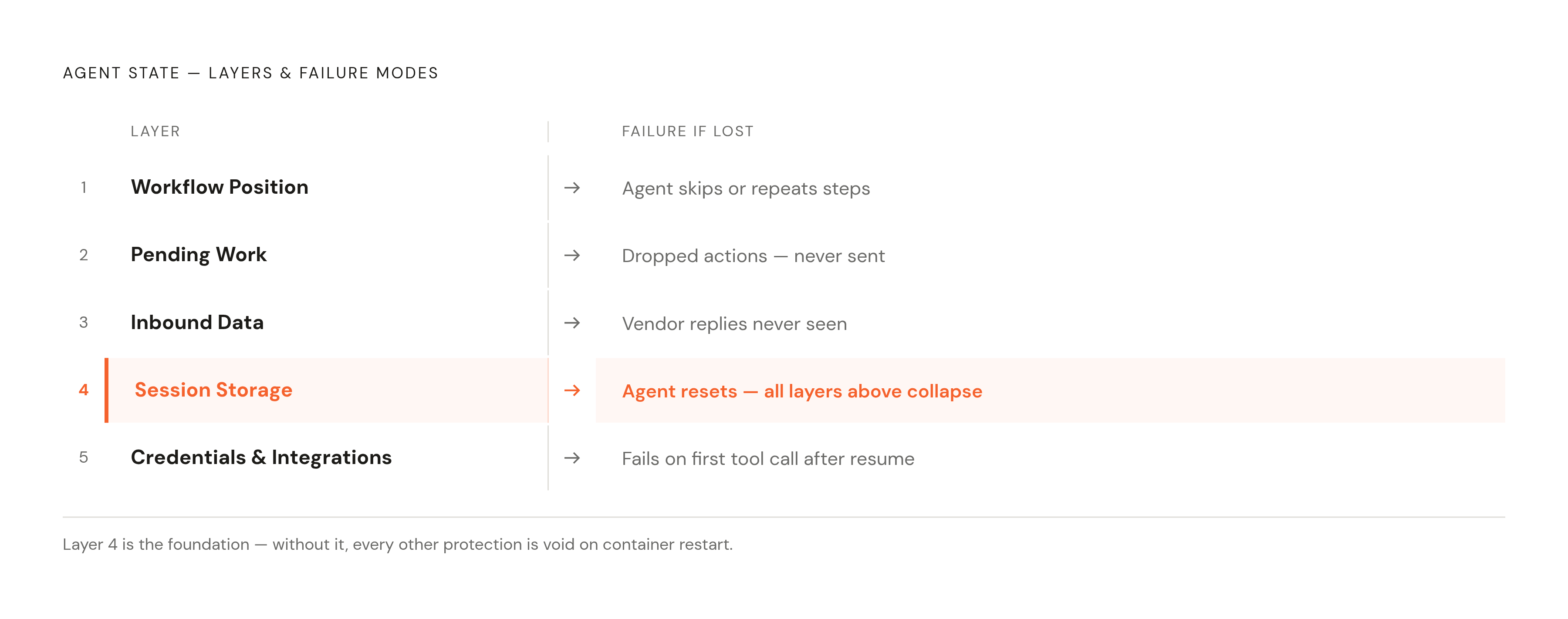
Fixing a pause starts with knowing what "state" means for a running agent. It's a bundle of distinct layers, and each one can be lost independently of the others. Each one needs its own protection.
The first layer is workflow position: which step in a multi-stage process the agent has actually reached. Google's ADK onboarding agent tracks this with named checkpoints, START, WELCOME_SENT, DOCUMENTS_SIGNED, IT_PROVISIONED, HARDWARE_DELIVERED, and COMPLETED, stored as an explicit state schema. The second is pending work: actions that are due but haven't executed yet, scheduled outbound emails, queued briefs, cadence triggers. These need to stay pending through the pause and fire once the agent resumes, without being dropped or fired twice.
The third layer is inbound data: messages and events that arrive while the agent is paused, email, Slack pings, webhook payloads. These have to be held unread or queued, not silently discarded and not processed without the context that would normally surround them. The fourth is session storage itself, the durable record of all of the above that survives container restarts, scale-to-zero events, and server crashes. Without durable session storage, every other layer is only as safe as the uptime of a single process. The fifth layer is credentials and integrations: tokens, API keys, service connections the agent needs the moment it starts working again. These need to persist across a multi-day gap without sitting live in memory the whole time.
Each layer fails differently when it's lost. Position loss causes the agent to skip or repeat steps in the workflow. Losing pending work causes dropped actions that nobody sent. Losing inbound data means missed signals, a vendor reply that never gets seen. Losing session storage sends the agent back to square one. Losing credentials means the agent resumes and fails on its very first tool call.
How a durable state machine keeps the agent oriented
The single most important architectural shift for an agent that pauses and resumes is replacing conversation history with an explicit state schema. Instead of scrolling back through everything that was said, the agent's system prompt reads its current position directly from session state variables. On resume, it knows exactly where it is without replaying a single old message, a pattern the ADK tutorial builds its onboarding example around.
The named-checkpoint pattern removes the ambiguity that causes hallucination. Six states, no overlap between them. The agent can't skip a step or invent progress that didn't happen, because the state machine enforces the sequence for it. It reads its state rather than reconstructing a guess from history, and that single distinction is what prevents the "remembered" approvals and skipped steps described earlier. The model sees its current checkpoint sitting in its system prompt and continues from exactly that point, with no context dump and no invented intermediate steps.
None of this works unless the state machine is backed by storage that survives infrastructure events. Containers cold-start, scale to zero during idle periods, and restart without warning. Sessions sitting in volatile memory get wiped out by any one of those events. Google's ADK handles this with a DatabaseSessionService, backed by SQLite for local development and PostgreSQL or MySQL in production. Switching that one configuration ensures every state write lands durably on disk, so killing and restarting the server in the middle of an onboarding run leaves the agent sitting at the correct checkpoint with every detail intact.
For workflows driven by outside events, there's a mechanism called state_delta that applies a state transition atomically, before the agent's next inference call, the moment a webhook fires. The model sees the updated state immediately and keeps going without replaying anything that came before it.
How a deliberate pause differs from stopping the scheduler
Good state architecture solves what the agent remembers. It doesn't solve what happens the moment a human decides to pause the whole thing, and that act needs its own design. A well-built pause holds work in place. It's a suspension, and the distinction matters for every action currently sitting in the queue.
The OpenExecutive pause implementation, built in September 2026, shows what a proper pause mechanism actually does. A single operator switch, stored as one row in a control table, gets checked by every scheduler loop on every iteration before it does any work. Due actions stay pending and fire on the first tick after resume, so nothing gets dropped along the way. Unread mail stays unread, because the email poller skips its poll entirely instead of processing messages without the context they'd normally arrive with. Anything already running at the moment of pause gets to finish, since a pause should never cut off an action mid-execution. The system also fails closed: if the pause state can't be read for any reason, work stays held rather than proceeding, so a missing table reads as "running" only in the sense that nothing happens, not in the sense that the agent starts acting blind.
Inbound conversations, web chat, Slack, Discord, Telegram, Google Chat messages, are deliberately left ungated in this design. They're human-initiated, so the agent can respond to them without needing the context of whatever outbound workflow is currently on hold.
Access control around pause and resume carries its own logic. In the OpenExecutive design, any signed-in user can trigger a pause, because pausing only holds work. Resuming is restricted to the principal alone, because resuming releases every held outbound action at once, and that's not a decision to leave open to just anyone with a login. The Personal-AI-1.2 pause implementation, from October 2026, builds in a stricter hierarchy on top of that idea: a pause set with an admin key carries a hold that only an admin can lift, returning a 403 creator_hold if anyone else tries, and a later pause never downgrades a hold set earlier. A supervisor agent can hold the agents:control permission without ever being able to overrule the owner's pause. These are the kinds of decisions real teams have had to make explicit rather than leave to default behavior, because the cost of getting resume authorization wrong is every held action firing at once, to the wrong recipient, at the wrong time.
Handling events and escalations that arrive while the agent is paused
Pause mechanics cover what happens to the agent's own outbound work. They say nothing about what arrives from the outside while the agent sits dormant, and that side needs separate handling because a paused agent cannot wake itself up. Something outside the agent has to watch for stale waits and time-sensitive events during the window it's gone.
Inbound events during a pause split into two categories, and each needs different treatment. The first is events the agent was actively waiting for before it paused: a document signature, a vendor reply, a hardware delivery confirmation. These should be queued and held so they're available the instant the agent resumes, not dropped and not processed out of order. The second is scheduled triggers that happen to fire during the pause window itself: cron-based briefs, cadence emails, monitoring sweeps. These should stay pending and run on the first tick after resume, which is exactly the pattern OpenExecutive implements for its scheduler loops.
Time-sensitive escalations need backend monitoring watching the situation, not the paused agent itself, since the agent has no way to notice its own dormancy. A cron job or timer can monitor checkpoint tables for threads that have gone stale. One escalation sequence works like this: at the moment of pause, the agent's status gets set to AWAITING_APPROVAL, and after a configured interval, a cron job detects that the thread has gone stale and routes an alert, a Slack ping to a secondary manager, for instance, so a human can decide whether to step in or let it wait for the operator's return.
None of this works without idempotency built into the resume moment. The agent has to be able to ask "did I already process this?" before acting on anything that arrived while it was away, so nothing that came in during the pause gets executed twice.
Credential and security hygiene across a multi-day pause
A multi-day pause opens up a specific kind of risk: the agent needs its integrations live and working the moment it resumes, but keeping active credentials sitting in memory for days while nothing is happening is an unnecessary attack surface to carry.
The safer pattern is per-run injection. The environment starts with nothing in it, no cloud role attached, no secrets mounted, no keys sitting in the environment variables. When the agent genuinely needs to touch a resource after resuming, a credential gets minted for that run specifically, scoped to exactly the resource it needs, valid for minutes rather than days, and injected as a file that only the relevant process reads. The metadata endpoint at 169.254.169.254 should be blocked outright, since it's the most common path by which code running in a sandbox escalates its way up to the host's own role.
The sandbox tier an agent runs in should match what it's actually doing. Multi-tenant workloads call for gVisor or a microVM. Untrusted AI-generated code needs the strongest isolation available, a Firecracker microVM.
For operators running on a managed hosting platform, the standard to hold the resume moment to is straightforward: an authenticated owner should be able to pause and resume the current agent session across worker restarts without the system starting new actions during the pause, replaying external writes that already went out, losing durable waits that were in progress, or reporting itself paused before the entire execution tree has actually gone quiet.
The resume checklist: what to verify before the agent starts acting again
Resume isn't a single action to take, it's a short sequence of checks, and skipping any one of them produces exactly the failures described earlier: duplicated work, missed context, stale credentials, or an agent confidently reporting progress that never actually occurred. Start by confirming the agent's checkpoint matches reality, that the state schema still reads DOCUMENTS_SIGNED or whatever step it was actually on, rather than something a container restart silently reset. Confirm that every piece of pending work queued before the pause is still sitting there intact, not dropped and not duplicated by an overlapping scheduler tick. Check the inbound queue for anything that arrived during the window, a vendor reply, a signed document, a Slack message, and make sure each item is still marked unprocessed. Verify that credentials are freshly minted for this run rather than stale tokens left over from before the pause began, since a credential valid for minutes doesn't survive a week of dormancy. Confirm the idempotency checks are in place before any held action fires, so nothing that happened while the agent was away gets executed a second time now that it's back. Make sure the resume event itself was triggered by the right person, the principal in the OpenExecutive model or an admin where a creator_hold applies in the Personal-AI-1.2 hierarchy, not just whoever happened to be signed in. And only once all of that checks out should the scheduler loops actually start releasing held outbound actions, because a resume that fires before state, queues, and credentials are all verified recreates the exact chaos the pause was built to prevent.