Prioritizing Agent Tasks When Multiple Jobs Are Queued
October 7, 202611 min read2,498 words
Text: Svetlana Korhonen
Composite scoring beats FIFO when tasks carry vastly different business impact and deadlines.
A customer escalation and a batch analytics job sit in the same queue. FIFO puts the analytics job first because it arrived first, and the escalation waits its turn behind it. That's the failure mode this article addresses: FIFO treats every job as interchangeable, when in a production agent system jobs carry wildly different consequence. One task costs a client relationship if it sits for twenty minutes. Another can sit for two days without anyone noticing. FIFO can't tell them apart, because FIFO was never built to.
People confuse prioritization with two neighboring ideas, and that confusion causes real damage. Routing decides which agent handles a task. Scheduling decides when a task runs. Prioritization ranks everything that's waiting, and it does that with a composite score, not by who got there first. These are three separate jobs, and solving one does not solve the others. A team that notices its queue is struggling often reaches for more agents, which is a routing fix, or for tighter cron windows, which is a scheduling fix. Neither touches the actual problem: the backlog itself is unranked. If you add ten more agents to an unranked queue, the customer escalation still waits behind the analytics job, just with more machines idling nearby. The queue degrades under load regardless of how many workers are pulling from it, because the order they pull in is still wrong.
The three signals that determine where a task belongs in the queue
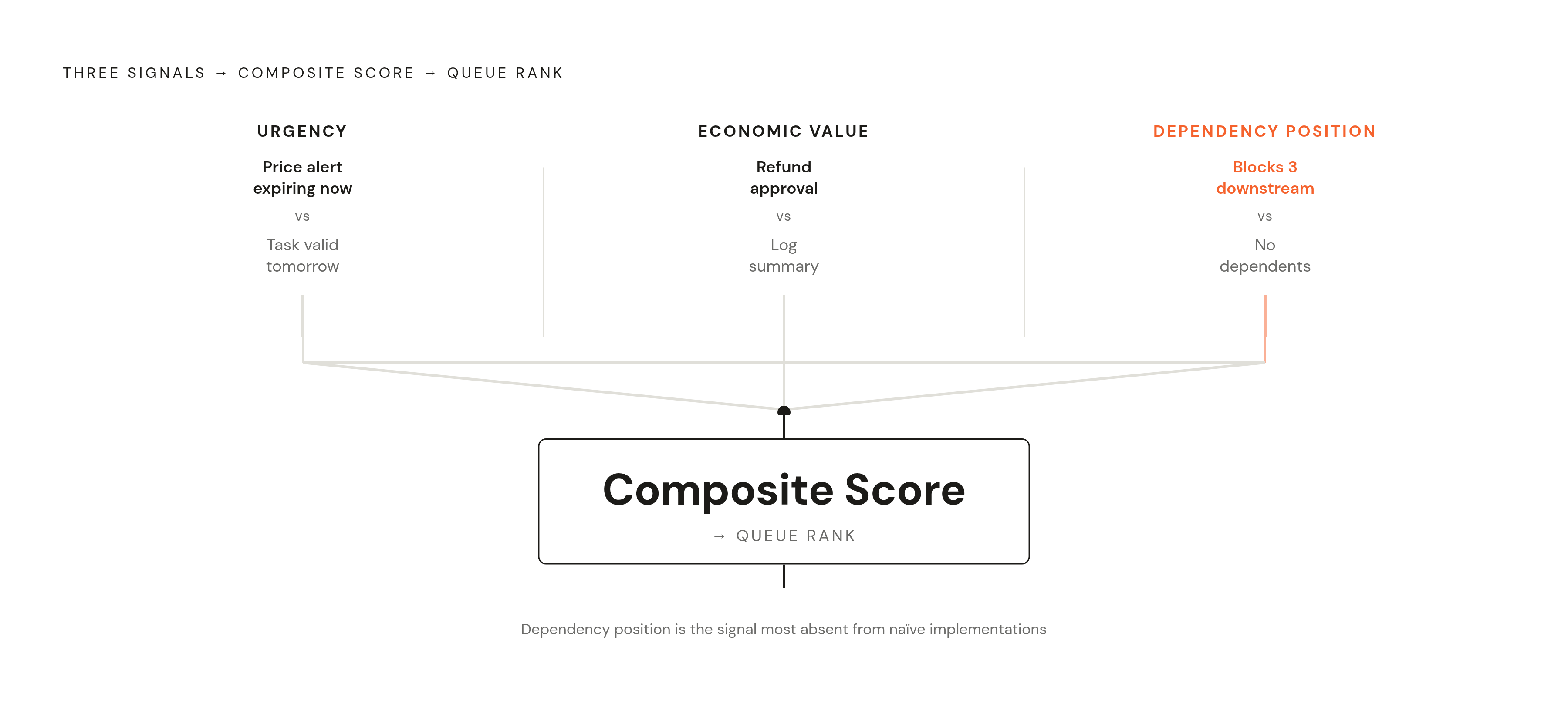
Three signals determine where a task belongs, and a working prioritization system has to read all three.
Urgency measures how close a deadline is, plus any external change that makes a task's value decay over time. A price alert that goes stale in minutes carries a different urgency profile than a task that remains just as valid tomorrow as it is today. A customer SLA window closing in an hour behaves nothing like an internal report due at the end of the month, even if both technically have deadlines attached.
Economic value measures the expected payoff of completing a task right now. Not all tasks pay the same when they finish. A refund approval keeps a client relationship intact, so it outweighs a routine log summary, even if the log summary takes less time to produce. Value and urgency are separate axes: a task can be high value with a loose deadline, or low value with a tight one.
A task's dependency position is where it sits inside a larger structure of blocking relationships. If a task blocks three other tasks, you should elevate it, because finishing it unlocks parallel work downstream. A task with no dependents can wait without consequence to anything else in the system.
None of these three signals can be computed without structured task metadata. At minimum, that means a title and description, acceptance criteria, an assigned priority level, and a deadline. Skip the metadata and urgency, value, and dependency position all become guesswork.
Reading these three signals well means distinguishing a cash-flow deadline from an internal administrative task, even when both appear on the same calendar date. Calendar position alone is a poor proxy for importance. A task due Friday that affects revenue collection is not the same as a task due Friday that affects an internal slide deck, and a system that reads only the date gets this wrong constantly.
Composite scoring and dynamic re-ranking in queue order
A single signal, sorted alone, produces a brittle queue. If you sort purely by urgency, you bury high-value work that has a loose deadline. Sort purely by value and time-sensitive tasks lose their value by the time they're reached. A composite score that weights urgency, value, and dependency position together, and recalculates as conditions change, is what turns three separate signals into one usable ranking.
The dynamic part matters as much as the weighting. Weighted fair queuing adjusts priorities based on real-time conditions and business rules, so it never locks in a score the moment a task enters the queue. A task's score at minute one and its score at minute sixty can be two different numbers, because the conditions that feed the score have moved.
Pure priority ordering carries its own failure mode: low-priority tasks can starve indefinitely if higher-priority work keeps arriving ahead of them. Aging corrects for this by raising a task's effective score the longer it waits, so patience itself becomes a factor in the score. A task that's been sitting for six hours earns ground on a task that just arrived, even if the new arrival started with a higher raw priority.
Re-ranking should trigger on state change: a dependency resolves, a deadline window closes, or a user escalates. Re-ranking every turn burns compute for no benefit. Re-ranking on a timer introduces lag between when something changes and when the queue reflects it. If you re-rank when a dependency resolves, when a deadline window closes, or when a user escalates, the queue stays accurate without constant churn.
All of this complexity earns its place under specific conditions: attention is scarce, the backlog is long, the spread of value across tasks is wide, and the ranking signals can actually be estimated from available metadata. But where those conditions don't hold, simpler mechanics do the job better, and that's what the next section takes up.
Google's autonomous task architecture patent, US 12,641,043 B2, granted May 2026, shows composite scoring as a formal architectural component. The patent describes a dedicated task prioritization agent that reads task prioritization configurations from a database and produces a prioritized task queue, which is then fed to execution agents. Prioritization sits as its own named piece of the system, separate from the agents that actually do the work. Ranking is a job in its own right, not a side effect of whichever agent happens to pick up a task next.
When FIFO plus lane isolation beats composite scoring
Composite scoring solves a problem of attention scarcity, where there's more valuable work than capacity to do it and the ranking has to reflect that gap. But if the real constraint is resource contention instead, strict FIFO plus lane-based execution is the better architecture, and layering composite scoring on top only adds complexity.
Lane isolation exists to keep one machine responsive, not to maximize the payoff of each individual turn. Separating expensive, compute-heavy operations into their own lane stops them from starving lightweight tasks, without requiring any ranking algorithm. The lane itself does the protective work.
FIFO plus lanes is the right call under a few conditions: a short backlog, a narrow spread of value across tasks where most jobs carry roughly equal priority, or signals that simply can't be estimated from the metadata on hand. If a queue handles routine, similarly weighted jobs, it doesn't need a scoring system to sort them well, because there's nothing meaningfully different between them to rank.
If every task in the queue is roughly as important as every other task, building a composite scoring system produces false precision. The resulting order isn't meaningfully better than FIFO would have given for free, and the system is harder to debug when something goes wrong. Complexity added without a corresponding gain in accuracy is a cost with no return.
Adaptive resource allocation in agent systems works the same way in practice. Dynamic scheduling earns its place when tasks differ materially in dependencies, deadlines, and business priority. The adaptation pays off exactly where the underlying tasks are genuinely different from each other, and contributes nothing where they aren't.
Parent-child hierarchies and dependency chains as structural inputs to ranking
Ranking tasks one at a time, in isolation from each other, produces a queue that looks correct task by task and still fails as a whole. Dependency and hierarchy have to feed into the score directly, so that bottleneck tasks rise to the top and orphaned work doesn't crowd out what the rest of the system is waiting on.
Real work breaks into subtasks with ordered relationships between them, a parent task and its children. A parent's priority should flow down to its subtasks, and if a subtask is blocking its parent's completion, it should inherit that elevated priority instead of sitting at whatever level it started with.
Blocking relationships deserve explicit weight in the score. A task blocking three downstream tasks isn't valuable only for what it produces on its own, it's valuable for what its completion unlocks. If you ignore this, queues end up with critical-path work sitting behind unrelated tasks that merely look urgent on their own terms. If a task blocks three others, it should outrank a task that blocks none, even when the solo task has a nearer deadline.
Dependency resolution itself is a re-rank trigger. When Task A finishes and Task B becomes unblocked, you need Task B's score to update right away, not on the next scheduled scan. This is the same state-change trigger from the scoring section, applied to a concrete and common event: one task finishing frees up another to move.
The Google patent architecture backs this up structurally. It describes multiple task queues, labeled Queue A through Queue Z, fed by an AI system that generates tasks, with a task prioritization agent retrieving tasks from those queues and ranking them. The structural metadata attached to each task, parent, dependents, blocking relationships, is what makes that ranking computable. Task decomposition from a natural language request produces exactly this kind of structured parameter set: task type, frequency, stakeholders, and dependencies, all of which feed directly into hierarchy-aware ranking.
How event-driven signals extend prioritization beyond the queue itself
A queue that only ranks tasks already sitting inside it misses the signals that matter most: the ones arriving from outside, in real time, that ought to trigger both enqueue and immediate prioritization at once.
Composio Triggers let an agent subscribe to events and kick off a workflow proactively, without waiting to be polled. Each trigger carries contextual metadata along with it, the source system, the event type, any labels or severity flags attached, and that metadata seeds the urgency signal the moment the task enters the queue.
Gmail makes this concrete. Incoming email can be read, labeled, urgent client, vendor invoice, newsletter, and enqueued with priority already assigned before an agent ever has to evaluate it fresh. A customer escalation arriving by email doesn't wait for the next scheduled scan of the queue. It enters the priority lane the moment the label gets attached.
The design consequence runs deeper than any single integration. Integrations aren't just surfaces where an agent takes action, they also feed prioritization signal. An agent wired into Slack, Gmail, and GitHub has three live urgency feeds that a queue operating in isolation simply doesn't have access to. Each one is a channel reporting on the state of the world outside the queue, and each one can change a task's rank before a human ever notices the need.
Continuous monitoring reflects the same principle from a different angle. When a quality inspection finishes, an agent can identify which downstream tasks are now free to proceed. The completion event works as a re-rank trigger in its own right, so it's never just a status update logged somewhere for later review.
Queue prioritization across orchestrators and sub-agents
In a multi-agent system, prioritization splits into two levels that both have to work for the system to behave correctly. The orchestrator ranks which tasks deserve dispatch. Sub-agent availability then constrains which of those ranked tasks can actually run right now. Get either level wrong and the queue can look perfectly ordered on paper while executing in a way that contradicts that order.
In a meta-orchestration pattern, the top-level agent holds the composite-scored queue and dispatches work to specialist sub-agents below it. The ranking logic lives at the orchestrator, not inside each individual sub-agent. A sub-agent never has to reason about its own priority relative to everything else in the system.
Sub-agent capacity feeds back up as its own signal. If the highest-ranked task needs a sub-agent that's currently saturated, the orchestrator faces a real choice: hold the task and preserve the integrity of the ranking, or dispatch the next-ranked task to whichever sub-agent is free and preserve throughput instead. Neither choice is automatically correct. It's a design decision made deliberately, with a clear understanding of which tradeoff the system is optimizing for at that moment.
Hermes Agent's persistent cross-session memory adds another layer to this feedback loop. Repeat task patterns, the same refund flow, the same content moderation check, get handled faster over time because the agent has seen them before. That changes how an orchestrator should weight urgency for a task Hermes has already encountered compared to a genuinely novel one landing in the queue for the first time. If a task is familiar, it might justify a lower urgency weight, because it will move through the system faster once dispatched.
Context engineering research frames the boundaries around what context an orchestrator passes to a sub-agent as a first-class architectural decision, not something inherited by default. The prioritization context handed down is scoped on purpose. What a sub-agent knows about why a task ranks where it does is chosen deliberately, not leaked in wholesale from the orchestrator's full view of the queue.
Security and isolation requirements that prioritization systems must enforce at the queue level
If a prioritization system spans multiple users or tenants, it creates an attack surface at the queue boundary itself. Resource exhaustion, prompt injection, and cascading failure all threaten the queue, and not just the underlying model.
An agent loop, an unbounded tool call, or an injection built to trigger excessive compute can eat up the queue's available capacity and push every other task down in priority, without ever touching the scoring logic. The task doesn't need to win the ranking if it can simply starve everything else of the resources needed to execute. The mitigation applies at queue entry, not after the fact: rate limits, token budget caps, session timeouts, and loop detection, applied per user and per team before a task ever gets the chance to consume shared capacity.
A compromised agent can also propagate malicious instructions upward to an orchestrator, corrupting the priority ranking it hands down to every sub-agent beneath it. Per-agent virtual keys with scoped permissions, combined with output guardrails enforced at the queue boundary, contain that blast radius before it spreads across the rest of the system.
Isolation at the infrastructure level sets the floor beneath all of this. Any agent acting on user-supplied prompts, or running in a multi-tenant context, needs a Firecracker microVM per workload for isolation. A shared container exposes the host kernel to every workload running on that node, which turns one compromised task into a risk for everything else sharing the machine. Prioritization and isolation are coupled by design: a queue that ranks tasks correctly but runs them in a shared, unisolated environment has solved the easier problem and left the harder one untouched.