Using GitHub as an Agent Trigger for Code Review Automation
October 3, 202610 min read2,299 words
Text: Dmitri Petrova
GitHub webhooks and Actions eliminate the hard work of detecting when code review matters most.
GitHub already does the hard part of building a review agent before anyone writes a line of code for one. The platform dispatches structured, filterable event payloads at every meaningful moment in a pull request's life. The trigger surface for an automated reviewer already exists inside every repository on GitHub.
Building a code review agent from scratch would normally mean watching a repository for changes, figuring out when something worth reviewing happened, and packaging that moment into something a program can act on. GitHub has already solved that problem. A PR opened, a new commit pushed to it, a draft promoted to ready, a PR closed or merged: each of these produces a discrete, named event with a structured body. The agent author's job becomes consuming and acting on these signals rather than instrumenting a repository to detect them.
GitHub Actions makes this even more concrete. Nothing needs to be installed or configured to get that delivery infrastructure running. It's there by default, in every repo, for every team.
That matters more than it might look at first glance, because the quality of a review agent has less to do with the intelligence of the model behind it and more to do with the discipline of the pipeline feeding it. Understanding the full event-to-action sequence, what GitHub sends, when it sends it, and what to do with each signal, is what separates a review agent that works in a demo from one that holds up in daily production use.
The pull request event lifecycle
A pull request generates a small, well-defined set of events, and each one signals something specific a reviewer would want to know about. Knowing what each moment means comes before any decision about which ones deserve the agent's attention.
Four events matter most for a review agent. And ready_for_review fires when a draft PR gets promoted to an actual review candidate, marking the moment a contributor is saying the work is ready for eyes.
Other events exist in the same stream, including closed and merged, but they serve a different purpose. Keeping that boundary clear from the start sets up the filtering decisions that follow.
Filtering events before the agent does any work
Reacting to every event a webhook receives is the most common early mistake in building a review agent. GitHub's webhook stream carries far more than the four events a review agent cares about, and treating all of them as equally actionable is what turns a useful bot into a noisy one.
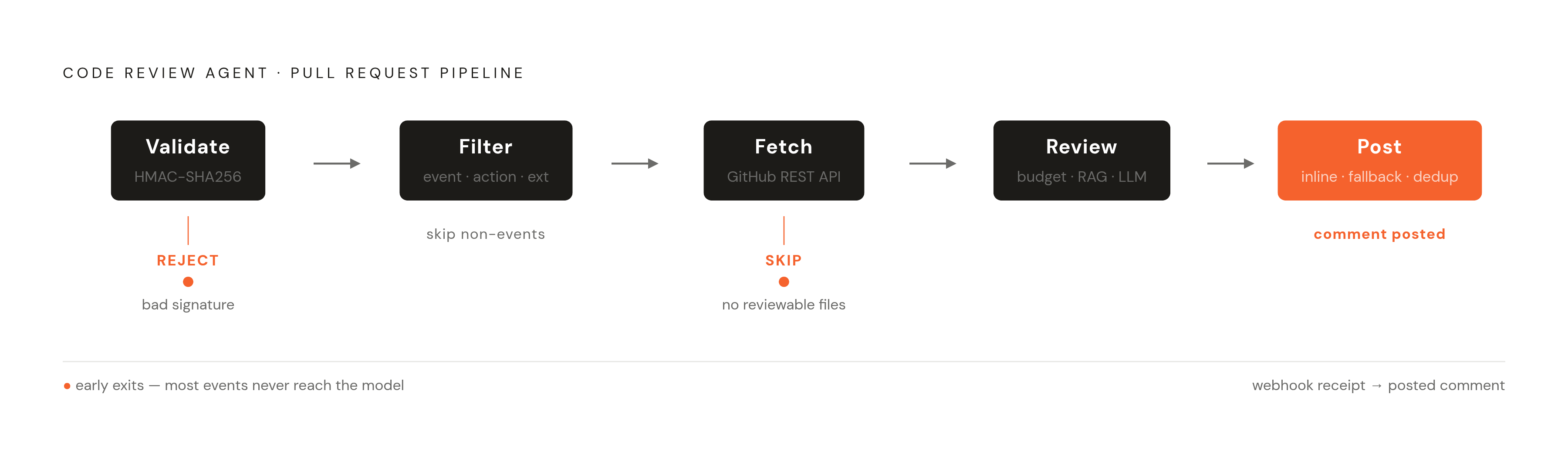
The first filter happens before the payload body is even parsed. GitHub sends an X-GitHub-Event header identifying the event type, and checking that header first lets the agent reject anything that isn't a pull_request event immediately, with minimal processing wasted on events it will never act on.
Once an event passes that check, the next filter looks at the action field inside the payload. The three actions worth responding to for a review agent are opened, synchronize, and ready_for_review. These map directly to the three moments a human reviewer would look up from their desk: a new PR appeared, a PR they're already watching just changed, or a draft just became real.
A third filter operates on the diff itself rather than the event metadata: filtering changed files down to reviewable extensions. Documentation files, image assets, and lockfiles rarely benefit from an LLM-driven code review, and passing their diffs into the pipeline anyway burns tokens without adding signal.
Skipping these filters isn't a shortcut that saves setup time. An agent that fires on every action ends up posting duplicate or irrelevant comments on PRs nobody asked it to review, and a team that sees that happen stops reading its output within a couple of cycles. Filtering is the mechanism that keeps the bot's comments worth opening.
Validating the webhook before trusting the payload
A webhook endpoint that processes whatever payload it receives, without checking where that payload came from, is an open door. Anyone who discovers the endpoint URL can send it a fabricated pull request event and get the agent to act on fictional data. HMAC signature validation is the step that closes that door.
GitHub signs every webhook payload with a shared secret using HMAC-SHA256, and includes that signature in the X-Hub-Signature-256 header. The receiving endpoint has to recompute the signature using its own copy of the secret and compare it against the header value before parsing anything else in the body. This check belongs at the very front of the pipeline, ahead of event routing or background task dispatch, so that nothing downstream ever touches an unverified payload.
The secret used for this check has to live as an environment variable, never hardcoded into source. The same rule applies to the GitHub token the agent uses to post comments back to a PR, and to the API key for whatever model powers the review itself. All three are credentials that, if exposed, let someone impersonate the agent or run up charges on an account that isn't theirs.
How the agent fetches the diff and builds its review inputs
A validated, filtered event is just a signal that something needs reviewing. The actual work starts with turning that signal into a diff the agent can reason about, and the decisions made at this stage shape whether the resulting review is sharp or scattered.
The agent pulls the repository name and pull request number out of the validated payload, then calls the GitHub REST API separately to retrieve the list of changed files and their diffs. That data doesn't arrive in the webhook body itself; it takes a dedicated API call after the event lands. From there, the same extraction-and-filtering pattern recurs: pull the repo name and PR number, fetch the PR's files from the GitHub API, and filter those files down to reviewable extensions before any of it reaches the review pipeline.
Diffs don't always fit neatly inside a model's context window, so token budget handling needs to be explicit rather than assumed. An empty diff gets marked as skippable rather than sent through the full pipeline for no reason.
Two additional layers improve what the model has to work with before it generates a single comment. A retrieval pass over a curated, team-specific standards corpus grounds the review in the conventions a particular team has actually settled on, rather than the generic best practices a general-purpose model defaults to. The two passes catch different kinds of problems, so running both isn't redundant effort, it's coverage.
What goes into the model at this stage determines what comes out of it. Getting the inputs right is most of the job.
Posting findings back to the PR without creating noise
A finding a developer can't locate in their code is a finding that gets ignored. The entire value of an automated review collapses if its output reads like a wall of disconnected text rather than comments attached to the lines they're actually about.
The GitHub REST API supports two comment formats for this purpose. Inline review comments attach to a specific file and line number within the diff. PR-level comments post to the general conversation thread instead, detached from any particular line. Inline comments are strongly preferable, because they preserve the connection between a finding and the exact code it concerns, which is what makes a review feel like a colleague pointed at a line rather than a bot dumping a list.
In practice, not every finding can be mapped cleanly to a diff line, so a fallback matters. Findings post as inline review comments on the changed file and line whenever that mapping is possible, and fall back to a PR-level comment only when it isn't. That fallback should stay the exception.
Bito's AI Code Review Agent illustrates what a fuller version of this output looks like in practice: it posts review comments directly within the corresponding pull request, and pairs them with a PR summary describing what changed, an estimated effort to review, and inline code suggestions a developer can apply directly.
Deduplication is the detail that keeps this system trustworthy over time. Checking for existing comments before posting new ones is what keeps the agent's output trustworthy the tenth time it runs, not just the first.
Two integration patterns: GitHub Actions vs. a standalone webhook service
The event-to-review loop described so far can run on two different kinds of infrastructure, and the choice between them is really a choice about how much operational surface a team wants to own.
The GitHub Actions pattern keeps the workflow file inside the repository itself, triggered on pull_request events, running the agent inside a fresh GitHub-hosted virtual machine each time. GitHub spins up a new Ubuntu VM, installs whatever dependencies the workflow specifies, and executes the agent script inside it. There's no server to provision and no infrastructure to maintain, and it costs nothing on the free tier. This pattern fits teams that want the agent's configuration version-controlled right alongside the code it reviews, and that can tolerate a review showing up a few minutes after a PR event rather than instantly.
The standalone webhook service pattern looks different. A persistent service, built with something like FastAPI or Express, receives the webhook directly, validates it, enqueues a background task, and returns a fast HTTP response immediately. The actual review pipeline runs separately, in a background worker, decoupled from the webhook response itself. Keeping that response fast matters because GitHub expects webhook endpoints to answer quickly, regardless of how long the underlying review takes.
This pattern becomes necessary under a few conditions: when the review pipeline is long-running, involving RAG retrieval, multi-agent orchestration, or large diffs that take real time to process; when the team needs to persist state across PRs, like tracking which findings have already been posted; or when the agent needs to call external services using credentials that shouldn't be exposed as GitHub Actions secrets.
A third pattern sits alongside these two: native GitHub Apps, which require no action YAML at all and respond to webhook events directly. Building one means registering an app inside GitHub's App framework and managing installation tokens, a heavier lift than either of the other two patterns. This is generally the path taken by fully productized review tools built for distribution across many teams, rather than an agent one team builds for its own internal use.
None of these three patterns is categorically better than the others. The right one depends on the complexity of the review pipeline and the infrastructure a team already has in place.
A worked example: the LangGraph security review pipeline from trigger to Slack alert
A LangGraph-based security review agent shows how the whole pipeline described above comes together as a sequence of discrete, testable steps, called nodes, with routing logic between them that goes beyond a simple script running top to bottom.
The flow starts the same way every pipeline in this piece starts: a developer pushes code and opens a PR. Inside that VM, a LangGraph state machine initializes and steps through a defined sequence of nodes. An analyze_code node sends the prepared diff to the AI model for review. A notify_slack node fires only if that risk score clears a defined threshold. A finalize node posts the complete report back to the PR as a comment, regardless of whether Slack got notified.
The routing decision inside score_evaluation is what separates this from a fixed script. Low-risk findings skip that node entirely and go straight to finalize, since a minor finding doesn't warrant interrupting anyone's day. That conditional branching, deciding which path to take based on the content of the review rather than running every step unconditionally, is the behavior that earns this system the label "agent" rather than "script."
The OWASP mapping step adds something a plain LLM review wouldn't produce on its own: a standardized taxonomy. Security teams already think in terms of the OWASP Top 10, and a finding that arrives pre-categorized against that framework can be acted on directly, without someone manually re-classifying it first.
Choosing the agent: what Claude Code, Codex, Bito, and PR-Agent each bring to a review loop
The trigger pipeline, the validation gate, the diff preparation, and the posting logic described in this piece all stay constant regardless of which model or tool actually generates the review. The agent sitting at the center of the loop is a substitutable component, and picking one comes down to how a team wants it triggered and how much control it wants over the review process itself.
Some tools are built for on-demand use, invoked directly against a diff or a specific PR rather than running automatically on every event. Others are designed from the ground up as autonomous pipelines that fetch, analyze, and post without a human initiating each run. Bito's agent, for instance, posts directly into the pull request with a summary of what changed, an estimate of how much effort the review will take to read through, and inline suggestions attached to specific lines, a shape built for teams that want the full loop running automatically with minimal setup.
Other approaches lean toward flexibility over polish: a lighter, more customizable pipeline that a team wires up with its own webhook service, its own filtering rules, and its own model choice, trading some convenience for control over how the agent behaves. The decision between a ready-made agent and a custom-built one comes down to whether a team needs the review loop to match its exact internal standards, or whether a general-purpose reviewer covers what the team actually needs without extra engineering. Either path runs on the same GitHub event foundation described throughout this piece, so getting that foundation right shapes how well any agent built on top of it performs.