Handing Off Agent Task Management When You Take a Break
October 14, 202610 min read2,270 words
Text: Svetlana Korhonen
Prepare your agent to work unsupervised by defining what it can do and when to stop.
Picture a founder who runs a small operation with an agent handling the daily grind: triaging email, pushing commits, keeping a project board current. Neither assumption holds anymore. Agents in 2026 don't just run discrete tasks and wait for the next one. They sit inside the coordination layer of the work itself, managing schedules, sorting intake, handling handoffs between tools, and keeping recurring projects moving on their own schedule. That shift changes what an absence means. Stepping away used to be a neutral event, a pause button. Now it's a moment where real risk can build up quietly while nobody's watching.
The practical consequence appears the moment you look at what's actually mid-flight when you log off. Left without deliberate structure, an agent handles that situation one of two ways, and both are bad. But fixing them costs time: redoing work, untangling conflicting states, and in the worst cases, undoing actions taken out in the real world that can't simply be rolled back.
What a handoff transfers
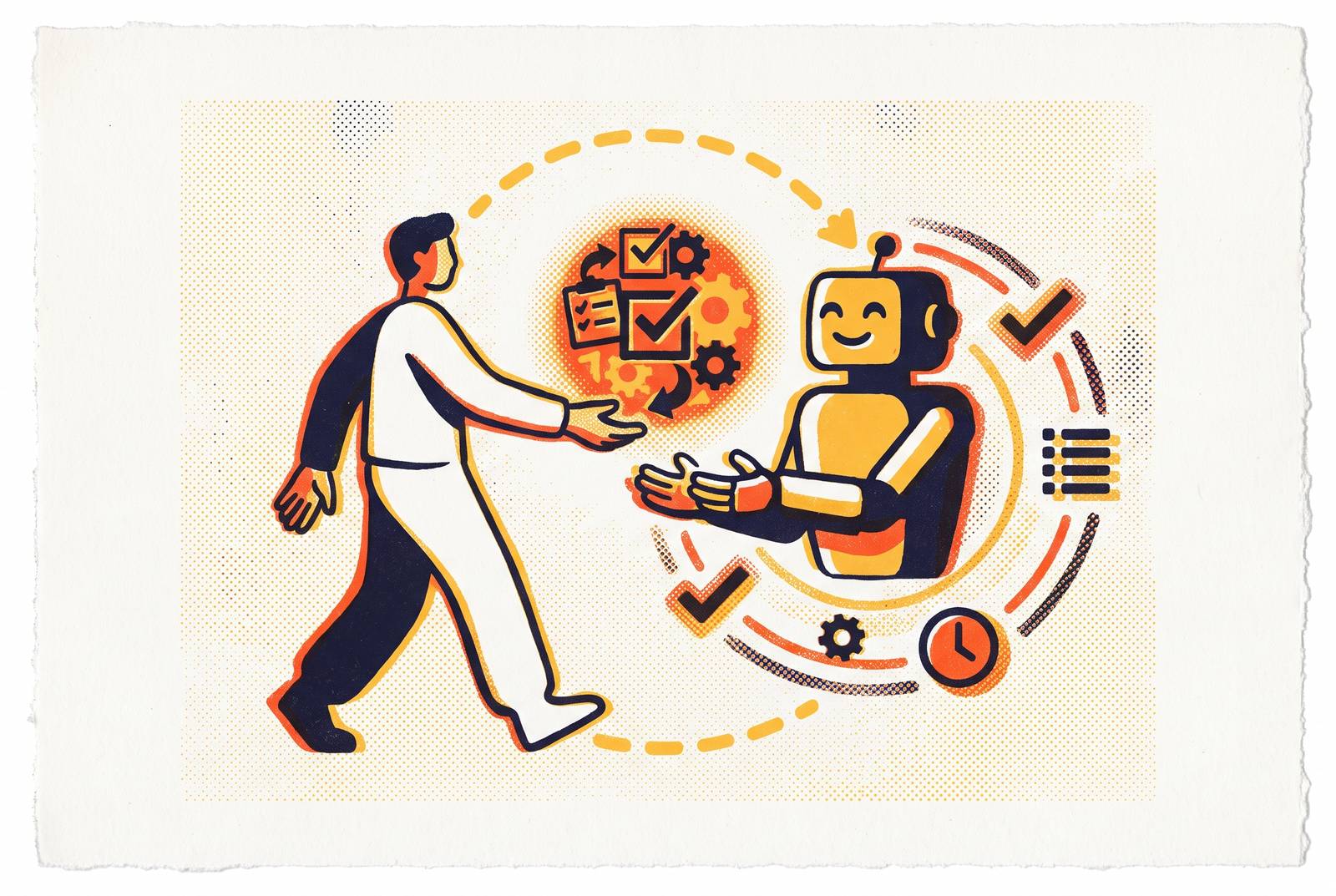
Handing a task to an agent before you step away is structurally the same thing as handing a task from one agent to another. Either way, three things need to move across: the task that's left to do, the context needed to do it well, and the authority to actually act. "I'll let the agent handle it" usually means the task got named, and nothing else got specified.
A handoff that actually works carries four distinct pieces of information. Without it, the agent either reaches past what it was ever authorized to touch, or freezes asking for a permission nobody's around to grant.
A fifth piece is not something you write yourself: provenance metadata. A good system tracks which agent, which instruction, which step produced each claim, so that when something goes wrong, you can trace it back to the exact place it started.
Two mistakes show up constantly here, sitting at opposite ends of the same problem. The agent treats that conclusion as settled fact, has no way to check it, and if it was wrong to begin with, that single early error becomes the foundation everything else gets built on.
Why silent authority transfer is the highest-stakes boundary gap
Out of the four fields, boundary is the one that does the most damage when it's missing. That's a guess, made live, not a specification anyone wrote down, and it often involves actions that reach out into the real world: sending something, publishing something, spending something.
Silent authority transfer is the failure mode worth taking seriously here. That's a handoff that spells out what to do but says nothing about what's permitted. The agent doesn't flag that it's making a judgment call under pressure; it just makes one, and you may only find out much later. Most people planning to step away for a weekend never ask themselves the one question that would catch this: what's the worst thing the agent could do right now, and has that specifically been ruled out?
A few concrete boundary questions should get answered before anyone leaves the building. Can it escalate a task to a sub-agent or an outside tool without checking in first, or does that always need a person's sign-off? And when it hits a decision point nobody thought to plan for, what does it do: stop, guess, or ask?
The handoff failure patterns that show up repeatedly, context flooding, context starvation, and silent authority transfer among them, all trace back to the same root cause. For agents running unattended, boundary needs one more piece: a stop condition, a specific point where the agent halts, writes down exactly where it is, and waits, instead of continuing to make judgment calls in a direction nobody's checking on.
Writing a handoff state document your agent can use
The handoff state document is the thing that actually carries all four fields, objective, state, evidence, and boundary, into the session your agent runs while you're gone. Writing it down is the step that separates a clean continuation from a slow drift into guesswork.
Start with the current objective, stated in a sentence or two as an end state rather than a procedure: "a merged pull request with passing tests," not "run the tests and merge if green." Finally, give it an escalation path: a specific Slack channel, a GitHub issue, a log file, somewhere concrete the agent can surface a blocked or halted state so you can actually find it when you get back.
One distinction matters here: the handoff state document is not the agent's system prompt. The objective and the boundary clause stay fixed run to run, and only the state block needs updating each time.
Matching your handoff structure to the agent runtime you're using
The four fields stay the same no matter what tool runs the agent, but how you load them in, and how well the agent holds onto them over time, depends a lot on the runtime. Picking the wrong tool for unattended work is itself a kind of boundary violation, since the tool simply can't honor the contract you're trying to set up.
OpenClaw is a community-governed, open source runtime with roughly 392,000 GitHub stars, and it works across Slack, Discord, Telegram, iMessage, WhatsApp, Teams, and more than 20 other platforms, with sub-agent orchestration built in from the start. That makes it a natural fit when a handoff needs to spread work across several specialized agents. For teams that want managed hosting instead of running their own servers, KiloClaw offers managed OpenClaw hosting at $55 a month, and NemoClaw, announced by NVIDIA at GTC in March 2026, is an open source stack that brings NVIDIA's own optimizations, including Nemotron local models and the OpenShell security runtime, to OpenClaw running on NVIDIA hardware.
Claude Code has a /goal command that sets a completion condition and keeps Claude working across multiple turns until that condition is met. It automates several turns inside a single session well, but it doesn't turn Claude Code into a persistent runtime the way Hermes is. Treating it as a tool for multi-day unattended work misreads what it's built for. Claude Code Channels, which shipped in March 2026, closes part of that gap for monitoring purposes: a plugin-based feature built on MCP servers that connects a running session to Telegram and Discord, with iMessage added about a week after launch, macOS only. It lets someone check in or get an escalation on their phone without sitting at a desk, even if the underlying session is still bound to one machine.
Codex, OpenAI's cloud agent offering, runs in sandboxed cloud environments and can execute multiple agents in parallel. Because the environment lives in the cloud, the agent keeps running whether or not the local machine that started it is even turned on, which matters a lot for engineering teams that want sandboxed, parallel execution without worrying about their own laptop's uptime.
A sensible setup for most people combines these rather than picking one: Claude Code for work done at the desk, Hermes or OpenClaw for background automation that needs to run while nobody's around, and a shared GitHub repo to keep skills, memory, and context in sync across all of them.
Connecting your agent to the systems it needs to act in while you're away
An agent can have a perfect objective, a clear sense of state, and a tightly written boundary clause, and still stall the moment it tries to act, if it doesn't have authenticated access to the systems it needs to touch. That access needs to be set up ahead of time, because it's a requirement for any handoff to actually function while you're gone.
The integration layer an agent relies on in production does two separate jobs. Unattended handoffs almost always need both, not just the ability to act but the ability to notice that something needs acting on.
Composio has become the standard integration layer for agents running in production. Its managed-auth approach means the agent connects an account at runtime, and the platform takes care of OAuth flows, API keys, token refresh, and the rest of the credential lifecycle, with permissions scoped to each individual connection. The platform carries SOC 2 Type II and ISO/IEC 27001:2022 certifications.
Which tools you connect before leaving is itself a boundary decision, not just a setup task to get through quickly. Connecting Gmail and GitHub but leaving Stripe out is a deliberate limit on what the agent is even capable of affecting while you're away, and it should be made with the same care as the written boundary clause itself.
Security and sandboxing requirements for agents running without you watching
A boundary clause is only as strong as the sandbox enforcing it.
Good sandboxing addresses five threat categories that matter most for agents running unattended: prompt injection, resource exhaustion, data exfiltration, lateral movement, and tool misuse. It does this two ways: by limiting which tools the agent can reach at all, so it physically cannot touch anything it wasn't explicitly granted, and by logging every tool invocation so there's a full record to check later. These aren't hypothetical concerns. Real infrastructure running real agents needs real sandbox discipline, and incidents like this are the reason why.
The architecture a team picks changes the security posture in a direct way. Self-hosted runtimes like OpenClaw and Hermes keep code on infrastructure the operator controls, though the LLM provider still sees code context during inference. Cloud agents like Codex send code out to the vendor's own virtual machines; the sandbox tends to be stronger, but the trust boundary shifts entirely onto the vendor's infrastructure.
For products serving multiple users, each agent instance needs its own enforced rules: deny dangerous commands outright, block access to sensitive file paths, restrict high-risk APIs, and require explicit approval before anything destructive happens. Observability belongs inside the security requirement, not off to the side as a nice-to-have. Logging every tool call is what makes it possible, on return, to check whether the agent stayed inside its boundary and to trace any problem back to the exact step that caused it. The security posture comes built in rather than something each team has to construct and maintain on its own.
What to check when you return
Coming back to an agent that ran without supervision is its own handoff event, just running in the opposite direction. The authority that got delegated on the way out needs to come back cleanly, and that takes the same structure as leaving did: a clear read on what's settled, what's still open, and what decisions the agent made on your behalf while nobody was checking.
The first thing to check is whether the agent stayed inside its boundary clause. Reviewing the tool invocation log before looking at results catches any action the agent took without clearance, before that action gets built on or acted on further. The escalation path set up before leaving should have a matching inbox waiting on return, whatever specific channel, a Slack message, a GitHub issue, a log file, was designated to catch a halted or blocked state. Systems that track this make an audit quick. Systems that don't turn it into real work.
A handful of states tend to show up on return, and each calls for something different. Clean completion means the agent finished the objective, stayed inside its boundary, and logged a final state. A halt at a stop condition means the agent hit a decision point or error threshold it was told to respect, and paused there. A stall without any logging usually means the agent ran out of context, hit a tool failure, or landed somewhere nobody anticipated, with no stop condition in place to catch it. And if the agent kept going past a point it shouldn't have, that traces back to a missing or too-loose boundary clause. Audit what it did, assess the damage, and tighten the boundary before the next handoff.
That return is also the right moment to update the handoff template for anything recurring. Each return gives new information to sharpen the next one, and over several cycles, that's what turns stepping away from a source of anxiety into a routine, low-stakes part of running things.
Where managed hosting fits at scale
Everything above works for a founder managing a single agent who can sit down and write a handoff document by hand, configure a sandbox personally, and check one log on return. At that scale, the handoff architecture has to live inside the platform itself.
The right unit for an agent-powered product is one isolated, persistent agent per customer, set up automatically the moment that customer signs up, not configured by hand for each new account as it arrives. Per-user sandboxing, in this setting, means each customer's agent carries its own boundary clause baked into the instance from the start, applying the same isolation principle described above for security at the level of the whole product instead of a single session: it can't reach another customer's data, tools, or sessions.
Managed hosting platforms that offer one-click deployment of agents like OpenClaw, Hermes, Claude Code, and Codex, often starting at accessible monthly prices, take the infrastructure labor off an operator's plate entirely: no VPS setup, no Docker configuration, no SSH access to manage, no manual monitoring, recovery, or update cycles for every single customer instance. The infrastructure and the handoff are the same problem, just asked at a different scale. Get the structure right for one agent, and the only thing left to solve is making that structure hold for a thousand of them at once.